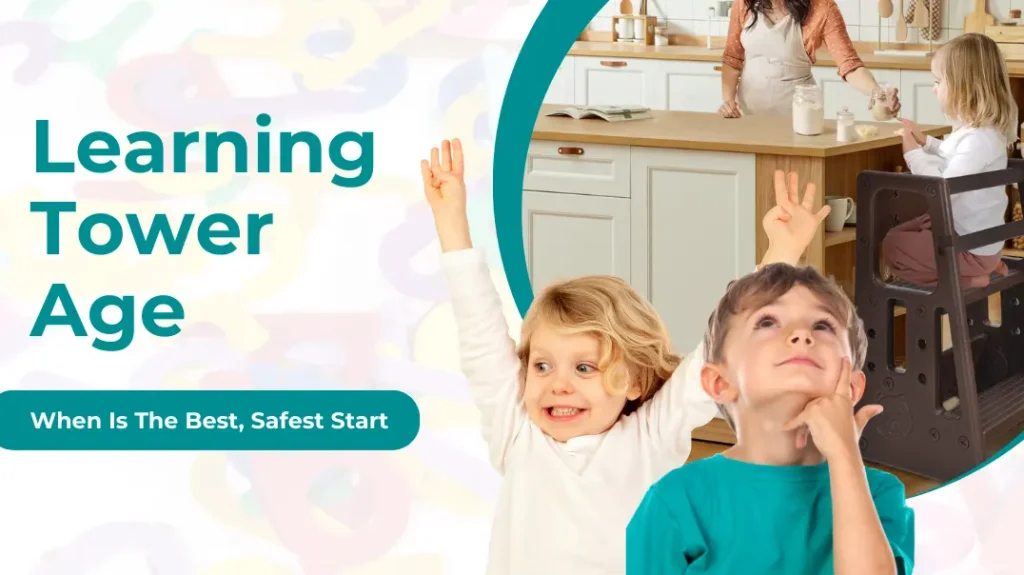
The safest Learning Tower Age for most children is roughly between 12 and 18 months, when they can stand steadily, climb a low step with control, and respond to simple limits. Rather than chasing the earliest possible start, look for this mix of balance, curiosity, and basic understanding. When those pieces line up, a Learning Tower becomes a secure way to bring your child to counter height without turning every session into a rescue mission.
That age window is only a guide. Some children are ready a little earlier, others closer to two years old, and a few need more time. What matters more than the number is how your child moves and behaves in your kitchen. If they can stay upright while excited, pause when you speak, and show a strong desire to join your work, you are probably entering your real Learning Tower Age.
Picture a typical evening. You are trying to cook, your toddler hangs on your leg, demands to be picked up, then twists to see the counter while your arm tightens around them. It feels unsafe and exhausting. Once your child hits that true Learning Tower Age, you invite them into the tower instead. They climb in, stand beside you at the right height, rinse a few vegetables, and stir a bowl while you stay close, hands free and shoulders finally relaxed.
What Are Learning Towers?
When you first hear about a learning tower, it often comes from a photo or a friend rather than a shop. A small child is standing at kitchen counter height, hands in a bowl, framed by a wooden structure that looks a bit like a mix of stool and mini balcony. For many parents, especially around the true Learning Tower Age, the real question is simple. What exactly is this thing, and how is it different from the furniture we already have at home.
Basic definition and Montessori concept
A learning tower is essentially a raised platform with guardrails, designed so a young child can stand at adult counter height with much more stability and containment than a simple step stool. Underneath all the product names and branding, that’s the core idea.
The concept grew alongside Montessori-inspired parenting. Montessori education has always emphasized giving children real tasks in real environments, not plastic imitations on the floor. So instead of a pretend kitchen, the child is invited into the actual kitchen. Instead of watching an adult from the ground, the child stands at the same height, with access to the same surface.
The learning tower is simply the piece of furniture that makes this possible in a way that feels reasonably safe.
When you look at it through that Montessori lens, the tower is not just “a stool with walls.” It’s a tool for three things at once:
- Physical access: reaching the sink, the counter, the work surface
- Psychological inclusion: being “on the same level” as the adults
- Gradual independence: doing more of the task themselves, step by step
That’s why Learning Tower Age matters so much. If you bring it in too early, the child doesn’t yet have the balance or understanding to use it safely. If you bring it in too late, you miss a window where they’re extremely curious and willing to imitate everything you do.
Learning tower vs. step stool vs. high chair
To understand why parents are concerned about the appropriate age for using a learning tower, it’s helpful to compare it to traditional tools already found in the home—such as stools and high chairs.
A stool is the simplest option. It usually has only one or two steps, and may have handles, but often lacks side railings. For older children with good balance and steady movements, a stool is perfectly fine. However, for toddlers who are prone to wiggling, tilting, and getting overly excited, using a stool can be somewhat risky.
Sometimes it’s easier to decide on Learning Tower Age when you see how the three common options actually differ in real use. Side-by-side, the trade-offs get clearer.
| Aspekt | Lernturm | Step Stool | High Chair |
|---|---|---|---|
| Typical suitable age | Around 12 months and up, if child is ready | Often 3 years and up with solid balance | From infancy up to about 2 to 3 years |
| Stability and base | Wide base, designed for toddlers | Narrower base, more likely to tip or rock | Very stable when used as intended |
| Side protection | Guardrails or panels around standing area | Little or no side protection | Full seat back, often with harness |
| Child posture | Standing at counter height | Standing on a narrow step | Sitting in a fixed position |
| Level of participation | Very high, at the same surface as adults | Medium, some access but more risk when moving | Low, mostly observing rather than helping |
| Freedom of movement | Free upper body inside a defined frame | Very free, but also more exposed to falls | Limited by straps and tray |
| Supervision needs | Constant, but with an extra margin of safety | Very high, one mistake can mean a quick fall | High, mainly to prevent climbing out |
| Fit with Montessori idea | Strong link with practical life activities | Partial, gives height but less controlled | Weak, good for feeding, not for real work |
| Longevity across ages | Adjustable designs cover several stages | Used more once the child is older and steady | Often outgrown once the child wants to stand |
Why are More and More People Choosing to Use Learning Towers?
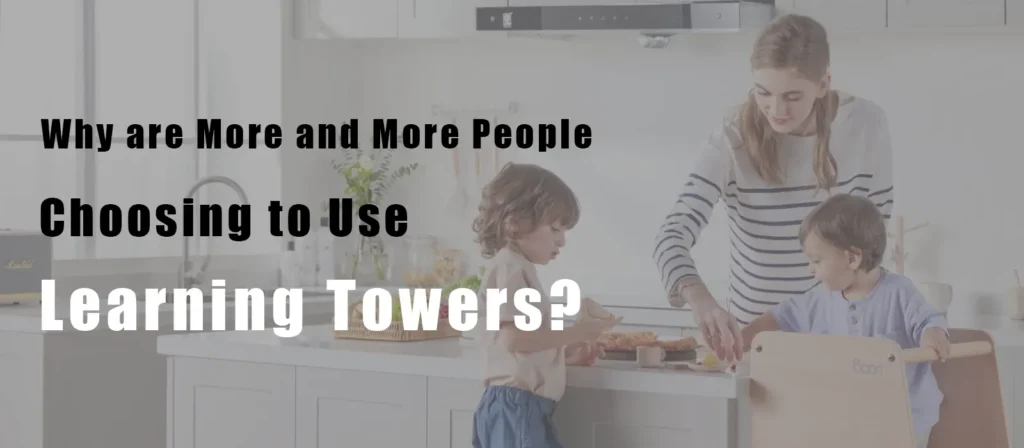
If you’ve noticed more and more friends, parenting bloggers, and retailers mentioning learning towers, it’s not just a photo trend. It often appears at a specific stage of family life. Your child is reluctant to stay on the floor and wants to participate in everything you do in the kitchen or bathroom, and you’re tired of cooking or cleaning while holding your child. At this point, many parents ask the same question in different ways: Is my child ready for a learning tower? Will it really make our daily life easier and safer?
Key benefits for children’s growth and independence
If you live with a toddler, you probably know this scene very well. You walk into the kitchen, and there is a small person right behind you. They pull on your clothes, ask to be picked up, try to see what is happening on the counter. They do not want to sit and watch. They want to do.
A learning tower exists mainly for that moment. Instead of keeping your child on the floor or in a chair at a distance, the tower gives them a stable place at your side. Same height. Same surface. Same ingredients. For a young child, that feels very different from being told to wait.
From a development point of view, that simple change does a lot of quiet work.
Your child has to climb in, turn around, hold the rail, find their balance. The body learns how to stay steady while the hands are busy. When they scoop flour, rinse vegetables, squeeze a sponge, those are not just nice photos. They are chances to practice grip, hand strength and coordination with a clear purpose.
The emotional side is just as important. Many toddlers are happiest when they feel useful. When you ask your child to add chopped fruit to a bowl or wipe a small spill, the message is clear. You trust them with real tasks. They are part of what the family is doing, not just watching adults move around above their head.
This is why the question of Learning Tower Age matters so much. If you bring the tower in when your child is close to ready, you get these benefits with a reasonable level of safety. If you push it too early, the tower becomes more of a climbing frame and less of a workspace. The goal is not just to stand higher. The goal is to be ready to join in.
Advantages for busy parents and caregivers
A learning tower lets you turn some of that unavoidable work into shared time without doubling the effort.
Instead of holding your child on one arm while stirring with the other, you can settle them into the tower and give them a job that fits their age. Stir this bowl. Put these pieces on the tray. Wash these few leaves. Your hands are freer. Your back does less lifting. Your child is close, busy and proud.
There is a safety relief too. Without a defined place at the counter, many toddlers find their own solutions. Climbing on ordinary chairs. Dragging stools across the floor. Leaning over sharp corners or hot surfaces. None of that feels good to watch. A well designed tower does not remove the need for supervision, but it pulls that energy into one clear, stable spot. You know where your child is. They know where they are allowed to be.
That is the deeper reason more families are asking about Learning Tower Age. They are not only shopping for a product. They are trying to balance three things at once. A child who needs attention and involvement. A home that was built for adults. And a routine that still has to run.
The Ideal Age to Introduce Learning Towers
Typically, you suddenly realize you need a learning tower. Your child has just learned to stand, or perhaps even walk. They’ll drag chairs to the kitchen counter or insist on being held every time you cook. At the same time, you worry about them falling, getting burned, or being cut by sharp tools. This is when the question of the appropriate age for a learning tower truly becomes relevant. It’s no longer just a number on a chart, but a real conflict between Unabhängigkeit and safety in your own kitchen.

Typical starting age range
Most brands and many pediatric therapists give a similar rough guideline. A learning tower is usually suitable somewhere around the end of the first year into the second year of life. For many children that means roughly 12 bis 18 Monate as a starting window.
Before that age, most babies are still working hard on basic standing and walking. They can pull to stand, but they often do not have enough control to climb, turn and stay stable on a raised platform. If you place them in a tower too early, they tend to treat it like a place to bounce, lean and test gravity rather than a workspace.
This is where a tower starts to make sense. It is not a guarantee. Some children are ready closer to 12 months, others closer to 18 or even 20. The key idea is that Learning Tower Age is a range, not a fixed rule.
Readiness signs that matter more than age
Age is a useful filter, but it is not enough. Two children of the same age can have very different balance, impulse control and understanding of limits. When you think about introducing a learning tower, it helps to look for a few specific readiness signs.
You can ask yourself simple questions like:
- Can my child stand unaided for a reasonable amount of time without falling often
- Can they climb up a low, broad step with some control, not just throw themselves forward
- Do they understand at least a few simple instructions such as wait, hold here, stop
- When they are excited, can they calm down a little with my voice and touch
For a very impulsive climber, you may choose to start a little later or with very clear limits and very short sessions. For a cautious child who craves participation but does not take big risks, you may feel comfortable starting nearer the earlier end of the range.
Situations where you may want to wait
There are some situations where the calendar age might say yes but your judgment should lean toward not yet.
You might want to wait or speak to a professional before introducing a learning tower if:
- Your child has ongoing balance or motor delays and is still struggling with safe standing
- They are recovering from a recent injury or surgery that affects movement
- They show very frequent jumping, throwing or head first diving from furniture
- You cannot realistically stay close to the tower during use because of other children or responsibilities
There is no need to rush. The tower will still be useful at two or even three years old. A slightly later start at a safer moment is better than an early start that leaves you constantly anxious and your child constantly being removed.
Benefits of Learning Towers for Different Age Groups
When parents ask about the Learning Tower Age, they usually want a single number. A clear starting point, maybe even an end point. Real life does not work quite that neatly. The same learning tower can feel like a very different object at different ages. Initially, it is almost a promise of what is to come. Later, it becomes a daily tool. Eventually, it turns into a stepping stone toward more independent positions in the kitchen or bathroom.
Looking at it by age group helps set expectations. You see what the tower can realistically bring to your child at each stage, and where its limits are.
Infants (under 1 year)

At this stage, most babies are still busy with very basic physical milestones. They are learning to roll, to sit, to pull themselves up on low furniture. Even those who can stand while holding on usually tire quickly or lose balance when they get excited. For that reason, the tower is rarely a good fit for regular, active use before the first birthday.
That does not mean nothing is happening. You are already building the foundation for later Learning Tower Age without calling it that. When your baby sits in a safe spot and watches you rinse vegetables, stir a pot or wash dishes, they are quietly absorbing the rhythm of your movements and the sounds of the kitchen. When you talk through what you are doing, even in simple language, you give shape to an environment that will later feel familiar when they finally stand at the same height.
So for infants, the real benefit is indirect. You are not using the tower as a tool for independence yet. You are preparing the body and the mind for that next step by giving plenty of time on the floor, letting them pull up on low, stable surfaces, and letting them observe you at work. When you finally move into active Learning Tower Age, none of this will feel sudden to your child.
Toddlers (2 to 3 years)
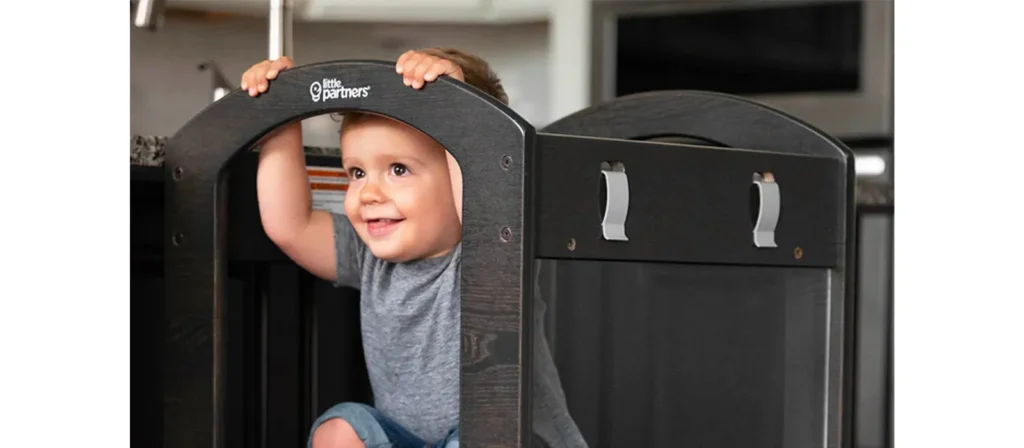
By the second and third year, the picture changes completely. This is the period when a learning tower usually earns its place in the kitchen. Your child is on their feet, able to climb small steps with some control, deeply curious about everything you do, and rarely satisfied with watching from below.
This is also the age where emotional benefits are obvious. Toddlers have a strong desire to do things “by myself” while still needing plenty of support. The tower gives you a way to satisfy that desire without handing over full control. You are close enough to guide their hands, close enough to redirect them when they reach for something unsafe, yet far enough that they experience the work as their own effort, not just your hands over theirs.
In this toddler window, the phrase Learning Tower Age makes the most sense. The furniture is not just possible to use. It is actively useful. It supports the developmental hunger for participation while keeping the risks at a level you can manage with close supervision and clear limits.
Preschoolers (4 to 6 years)

Between four and six, many children move from simple participation to genuine contribution. They remember steps, they understand why certain rules exist, and they can stay focused on a task for more than a few seconds. A learning tower can stay relevant here as a stable workstation rather than just a boost.
At this stage, you might notice that your child starts to take ownership of specific jobs. They always wash certain fruits. They always help mix a sauce. They take responsibility for setting out a part of the meal. The tower reinforces that role. It becomes the place where they stand not only to copy, but to execute something they already know. That predictability deepens their sense of competence.
So for preschoolers, the benefit is not only about physical access. It is about consolidating skills and attitudes that will carry into later childhood. In that sense, Learning Tower Age is not something that stops at three. It stretches into these older years as long as the tower continues to provide a stable, respectful way for your child to stand beside you and take real part in family work.
Safety Precautions for Using Learning Tower
Once parents start looking at the Learning Tower Age, safety is usually the next thought that comes to mind. You are thinking about giving your child access to real work surfaces in real rooms, not in a soft play corner. That shift brings a lot of benefits, but it also pushes you to look more carefully at the object itself, where it will stand, and how it will be used day after day. Safety here is not just one feature on a product page. It is a mix of design, placement, and routine in your own home.
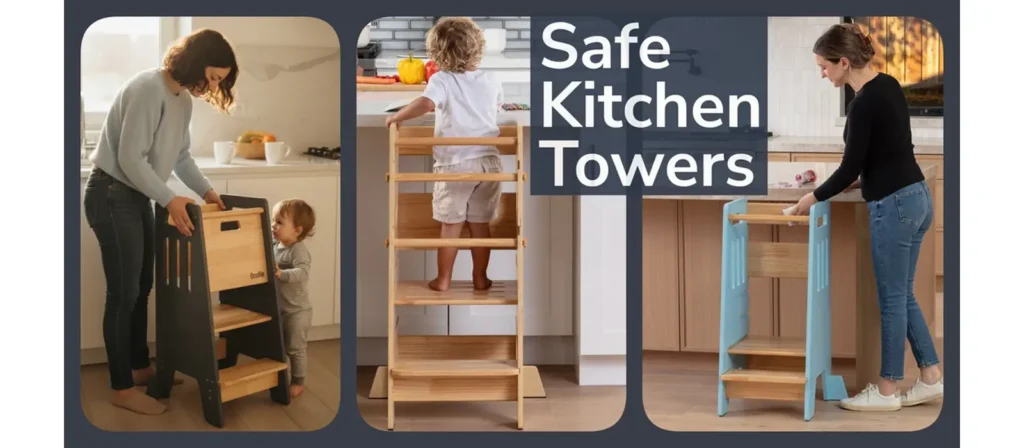
Must have safety features before you buy
Before a learning tower comes into your kitchen, most of the safety outcome is already hidden in how it is built. This is the one moment where it really pays to be picky, especially if you are thinking about the younger Learning Tower Age range.
- Stable, wide base
The base should feel planted when you push it from the side with your hand. No rocking, no light sliding across the floor. A wider footprint front to back and side to side gives the tower more resistance if your child leans or shifts weight suddenly. - Deep, secure standing platform
The standing surface needs enough depth and width that small feet can move a little without ending up on the edge every time. When you imagine your child turning around or adjusting their stance, there should still be platform under their feet, not empty air. - High, enclosing side panels or guardrails
Rails or panels should sit clearly above the child’s center of gravity at the expected starting height. That way, if they lean sideways or backwards, they meet a solid barrier instead of tipping straight out. Open sides that only frame the legs do much less for real safety. - Adjustable platform height with solid locking
Height adjustment is not just a nice extra. In the early Learning Tower Age window a small change in platform height can decide whether your child must stretch and lean or can stand upright with relaxed shoulders. The mechanism that holds each height needs to feel firm, with no sense that a kick or a bounce could shake it loose. - Robust materials and clean construction
Solid wood or sturdy boards give a more grounded feeling than very light, thin pieces. Surfaces should be smooth to the touch, with rounded edges where a child might grab or bump. Screws and fixings sit flush or slightly recessed so clothes and skin do not catch. If the tower is painted or finished, the coating should be clearly described as suitable for children. - Clear weight and age guidance from the maker
Honest information about maximum weight and suggested age range is helpful. It does not replace your judgment, but it tells you what the design was built to handle. If the numbers sound unrealistic for your situation, that is already a warning sign. - Reference to relevant safety testing where possible
In regions where children’s furniture must follow safety standards, it is reassuring to see those mentioned. They do not automatically make a product perfect, yet they do show that someone has checked basic structure and materials against external criteria. You still bring it back to a simple question. When you picture your own child climbing in, do you feel reasonably calm.
Common safety risks and how to avoid them
The risks around a learning tower are not mysterious. Parents who use one for a while tend to describe the same few situations. Knowing them in advance makes them easier to prevent.
Falls are the first concern. They usually happen when the tower is being used more like a climbing frame than like a standing platform. A child stands on the rails instead of the platform, leans far over the counter, or tries to climb in from the side. If that becomes the usual pattern, something about the setup needs to change. Sometimes it means the child is still a bit young for regular use and needs more time. Sometimes it means the rules have been too loose and need to be restated in simple, steady language. The tower is for standing inside, facing the counter, while an adult is nearby. Holding that line, gently but consistently, does a lot for safety.
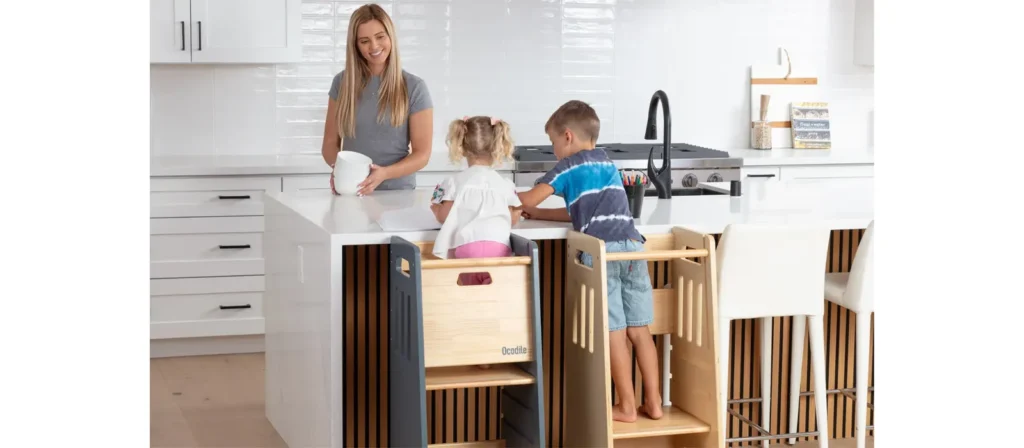
One more, quieter risk is the simmering anxiety of the adult. If every tower session leaves you feeling on edge, if you find yourself snapping at your child or ending the activity abruptly, that is useful information. It does not necessarily mean the tower is a bad idea. It might mean the starting age was a little early, or that the tower is too close to obvious dangers, or that there are too many distractions while your child is up there. Adjusting those factors often lowers the background stress for everyone.
When the choice of product, the position in your home and your daily routine all line up, the learning tower stops feeling like an experiment and starts to feel like part of the kitchen. Your child can stand beside you with a clear role. You can focus on both safety and connection. That balance is what most parents are actually searching for when they begin asking detailed questions about Learning Tower Age.
How to Choose the Right Learning Tower by Age and Home Space
Once you have a rough idea of Learning Tower Age for your child, the next question is very practical. Which tower actually fits your child and your home. Photos online can make them all look similar. In reality, a tower that works beautifully in a wide, open kitchen for a calm two year old can feel completely wrong in a narrow galley kitchen with a very active eighteen month old. Choosing well is mostly about matching three things. Your child’s stage, your daily routine and the space where the tower will live.
Matching the tower to your child’s age and temperament
Age is only one layer. At the younger Learning Tower Age a more enclosing tower with higher sides and a low platform helps a child who is still learning balance and limits. Near three years, a steadier child can use a slightly more open design. Think about how your child moves, not just the number on the birthday cake.
Fitting the tower into your kitchen and bathroom
Your kitchen or bathroom decides more than you expect. In a wide room almost any stable tower can fit near a safe work zone away from heat and knives. In a narrow galley space depth and width matter. Measure doors, drawers and walking paths so the tower has a clear home that does not block how you already move.
Thinking about multiple children and long term use
With more than one child, Learning Tower Age stretches over years. A slightly larger, adjustable tower can serve a younger sibling after the older one moves on. The platform needs to grow with changing height and tasks. Consider whether you have space to store it between stages without it becoming clutter.
Abschluss
Choosing the right Learning Tower Age is less about hitting a perfect number and more about matching your real child, in your real kitchen, to a tool that makes sense. When balance, curiosity and basic rule following come together, a learning tower turns ordinary routines into practice grounds for independence. Your child moves from watching to helping, and you move from constant no to more yes, without pretending the risks of height, heat and tools are not there.
Over time the tower does its job quietly and then steps out of the way. It carries your child through a phase where they are too small for the counter yet too big to be left out. When they finally stand taller than the rails and handle tasks from a stool or low table, you can retire the tower knowing it has already shaped how they see work, family and their place beside you. That is the real measure of a good learning tower, far beyond the age printed on the box.





 DE
DE  EN
EN  AR
AR  FR
FR  IT
IT  ES
ES  TH
TH  JA
JA  TR
TR