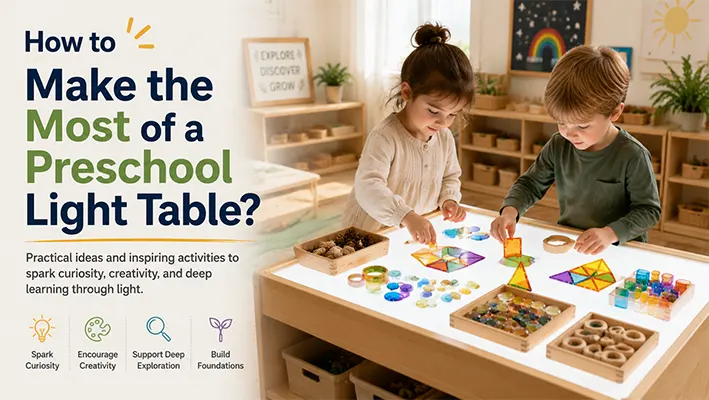
Preschool light table is more than a table that lights up. Its real value lies in making everyday materials easier for children to observe, compare, arrange, and explore. To make the most of it, focus on thoughtful placement, versatile materials, teacher guidance, and activities that extend learning beyond the illuminated surface.
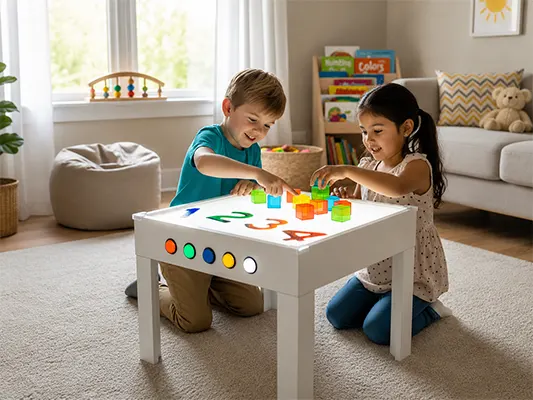
How can we make the most of a light table in terms of space and usage?
Choose a location where you can see the light clearly.
A desk should not be placed directly in strong sunlight, nor should it be placed in a completely dark corner. The surrounding environment should highlight the desk’s light while maintaining normal classroom lighting.
Control the number of children using at the same time
Don’t let too many children crowd together just because there’s space on the table. An appropriate number of children reduces competition and gives each child a real opportunity to participate and express themselves.
Store materials nearby
Frequently used materials should be placed where children can see and reach them, but they don’t all need to be placed on the table. Low lockers nearby can help children choose, use, and return materials independently.
Keep the surrounding traffic flow clear
Desks should not be placed in the main aisles of the classroom. Children need enough space to move around, fully utilize their creativity and inspiration, and to communicate and collaborate with their peers around the table.
How can you determine if a light table is being fully utilized?
Don’t just look at whether a child is willing to sit at a bare table; also observe:
Will the child repeatedly try different methods?
Will you ask questions or express your findings?
Is it possible to create different works using the same material?
Do you discuss and cooperate with your partners?
Can the experience be extended to other learning areas?
If a child only plays with the materials briefly or repeats the same play method for a long time, it means that the materials, questions, or difficulty of the activity need to be adjusted.
How to expand the usability of light tables
- To truly make the most of a light desk, learning needs to continue even after the student leaves the desk.
- The activity can be extended to:
- Draw the colors and patterns on the light table in the art area.
- The structure on the light table was rebuilt in the construction area.
- Recording observations of natural materials in the science zone
- Telling the story of creation on the light table in the language area
- Photographing children’s artwork for display and learning documentation.
- Develop the child’s questions into a small project that lasts for several days.
- In this way, the “light table” activity is no longer a one-off event, but the starting point for curriculum development.
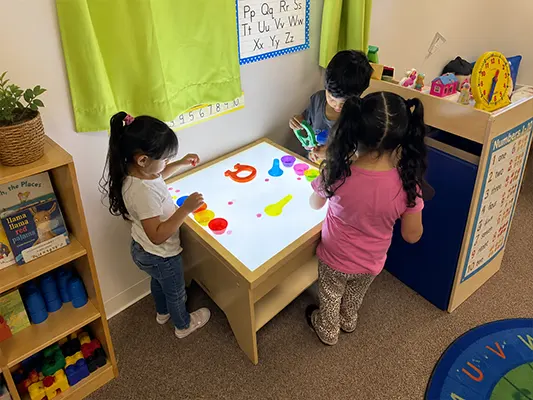
How to choose a suitable light table for a kindergarten?
When choosing a Preschool Light Table, do not focus only on size or appearance. Think about how children will use it every day, where it will be placed, and what types of activities you plan to offer.
Choose the Right Working Height
The table should match the children’s age and usual working position. A lower model is better for toddlers or floor-based activities, while a standard-height table may suit children who work standing or seated on chairs. For mixed-age classrooms, an adjustable model or a table that works with different chair heights is more practical.
Check the Light Quality
Choose a table with even, diffused lighting and no obvious bright spots. The surface should be bright enough to show colors and details clearly without causing glare. Adjustable brightness is useful when you switch between tracing, construction, and sensory activities.
Look for a Durable, Safe Surface
The tabletop should resist scratches, stains, and frequent cleaning. Rounded corners and smooth edges are especially important in busy preschool classrooms. You should also check whether the surface stays cool during extended use.
Decide Whether You Need Storage
Built-in shelves or compartments are useful when the light table is used every day. They allow children to reach and return transparent blocks, tracing cards, and sorting materials independently. If your classroom already has nearby storage, a simpler model may be enough.
Consider Mobility and Cleaning
A mobile light table works well when you regularly rearrange learning centers, but the casters should lock securely during use. Choose a sealed, wipe-clean surface without deep gaps where dirt or liquids can collect.
Check the Power Design and Warranty
Make sure the cord can be kept away from walkways and children’s feet. A protected switch, secure power connection, and clear cord-management design will make daily use safer. Before purchasing, confirm the warranty period and whether the light source or electrical parts can be replaced.
How to choose a suitable lamp table in a kindergarten
Different light tables have different structures, are suitable for different age groups, and correspond to different activities. When choosing one, you should not only look at its appearance, but also consider the classroom space, the child’s age, and the intended use.
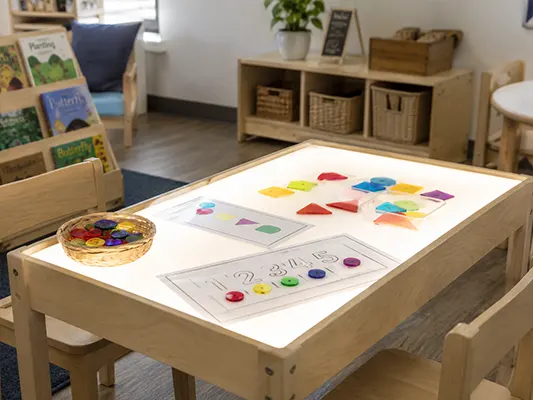
- 1. Standard Flat Light Tables
- The most common flat light table is suitable for color observation, puzzles, tracing, sorting and construction activities.
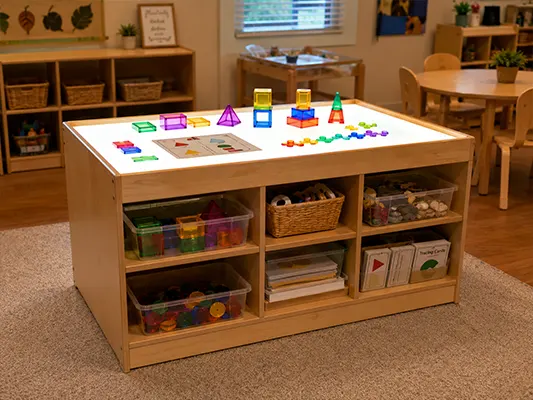
- 2. Light Tables with Storage
- A light table with storage is suitable for classrooms with a lot of materials where children are encouraged to take things out and put them away independently.
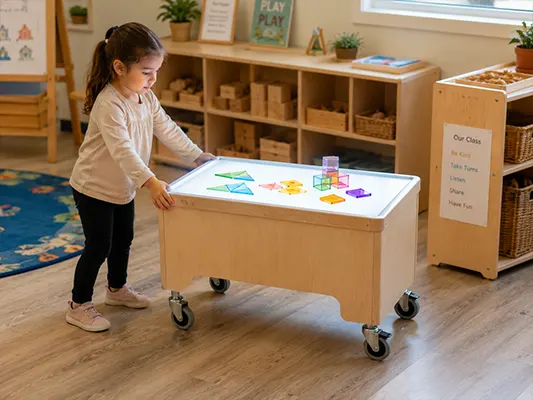
- 3. Portable or Mobile Light Tables
- Movable light tables are suitable for classrooms with limited space or where flexible area adjustments are needed.
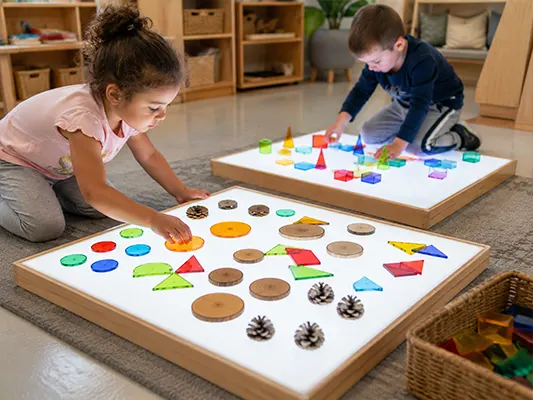
- 4. Floor Light Panels or Light Boards
- Ground-level light panels or lightweight light panels are more suitable for younger children and are also convenient for combining with large, loose materials for ground exploration.
- 5. Sensory Light Tables with Trays
- Light tables with shallow trays or sensory trays are suitable for sensory activities involving sand, water, transparent materials, and natural materials.
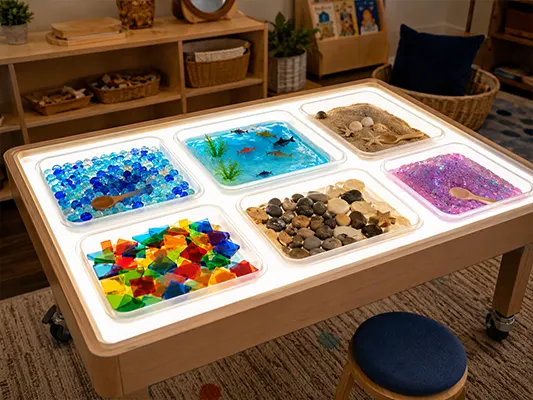
- If your primary goal is to support artistic creation, tracing, and desktop exploration, a standard flat lamp table may suffice. If you want children to have independent access to materials, a lamp table with storage space might be more suitable. If your classroom requires flexibility, a portable lamp table might be a more practical option.
What materials and accessories can be used for kindergarten lamp tables?
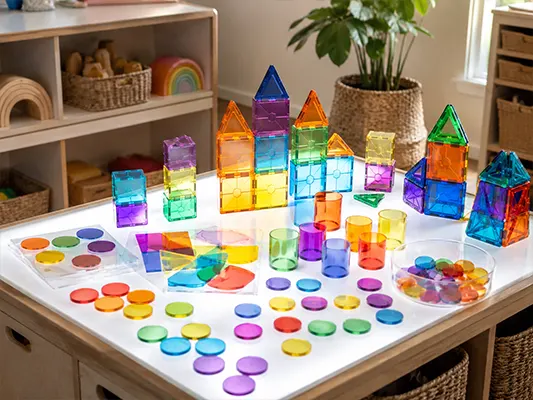
- 1. Building Materials
- Transparent building blocks
- Magnetic tiles
- Acrylic graphic film
- Transparent cup, transparent disc
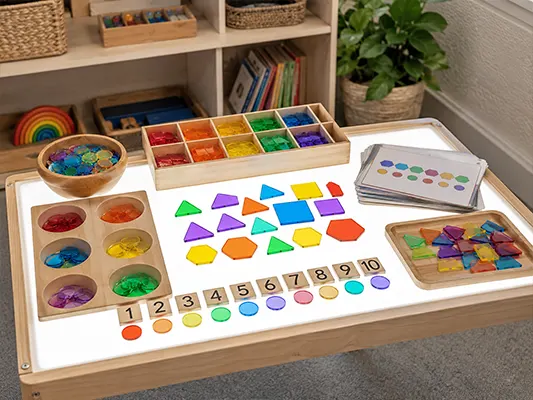
- 2. Math Materials
- Digital chips
- Counting plate
- Geometric shapes
- sorting tray
- Pattern cards
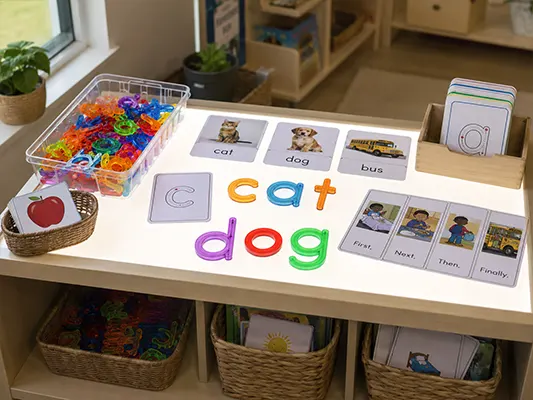
- 3. Literacy Materials
- Transparent letters
- Letter tracing cards
- Word cards
- Story sequence cards
- 4. Nature and Science Materials
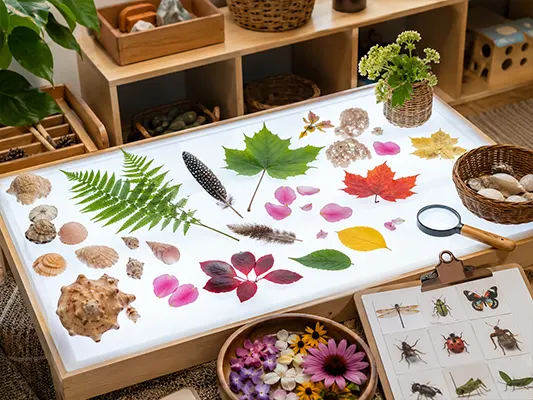
- Leaves
- petal
- feather
- shell
- Insect Observation Chart
- 5. Art and Creative Materials
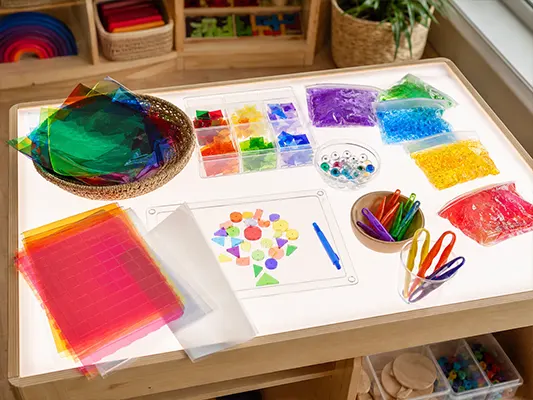
- Colored transparent film
- cellophane
- Transparent mosaic
- Erasable transparent board
- tracing paper
How can we create more ways to play with fewer materials?
Making the most of a light table doesn’t mean filling it with materials all at once, but rather increasing the depth of use for each material. Choose open-ended materials: transparent blocks, magnetic tiles, acrylic shapes, natural materials, and loose parts. There’s no single way to play, making it easier to support children’s long-term exploration.
Mix materials with different levels of transparency. Provide transparent, semi-transparent, and opaque materials simultaneously, guiding children to compare which materials allow light to pass through, block light, or change color.
Design multiple tasks with a single material. For example, transparent geometric pieces can not only be used for sorting but also for color mixing, pattern design, symmetry, counting, and story creation.
Rotate a few materials, rather than replacing them all. Retaining familiar materials and adding one or two new elements often sustains exploration more effectively than completely changing the entire activity.
Case studies of activities that truly realize the value of the light table
Several Light Table Activities That Truly Maximize the Value of Light Tables
The light table should not be a standalone toy unrelated to the course, but rather a tool used by multiple learning areas,Fully develop children’s logical thinking skills.
Mathematics learning
Used for counting, classification, pattern recognition, shape and size comparison, symmetry, and spatial arrangement.
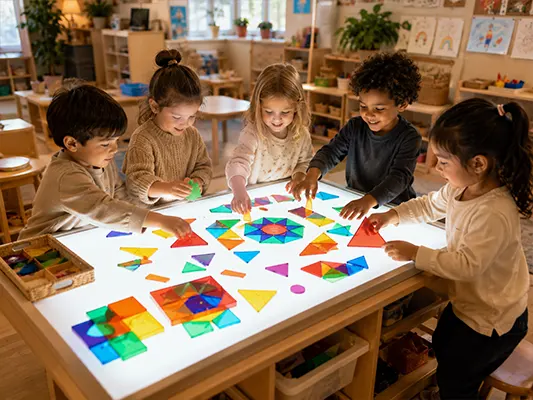
Symmetrical Pattern Challenge (Graphic Logic Training)
Suitable Age: 4-6 years old
Materials: Transparent geometric pieces, mirrored panels, center line cards
First, place a clear dividing line in the center of a lighted table. The teacher arranges several shapes on one side, and the children complete the same arrangement on the other side.
Once familiar, children can design their own half of the pattern and then invite a partner to complete the other half.
The teacher can ask: What’s the same on both sides? If you move a triangle on one side, how should you change the other side?
Learning Value: Symmetry, positional relationships, shape recognition, and visual judgment.
Scientific exploration
Observe the details of light transmission, color changes, shadows, plant structure, insect wings, feathers, and natural materials.
Case Study: Uncovering the Secrets in a Leaf (Sensory Training)
Suitable Age: 3-5 years old Materials: Leaves of different shapes, petals, magnifying glass, transparent tray
Place the leaves your child collected outdoors on a light-filled table. The veins, edges, and small tears will be clearer than on a regular table.
You can guide your child to compare:
Which leaf has the most veins?
Which leaf is more translucent?
What are the differences between the edges of the two leaves?
After the activity, children can classify the leaves by shape, color, or veins and take their observations to the science area for further investigation.
Learning Value: Nature observation, classification, comparison, and early scientific inquiry.
Language and Storytelling
Use transparent letters, characters, animals, and scene materials for letter combinations, story sequencing, and situational storytelling.
Case Study: Telling a Story on a Light Table (Language Expression and Imagination Development)
Suitable Age: 3-5 years old
Materials: Transparent figures, animals, trees, houses, and scene graphics
Place a small number of story characters on a light table; the plot doesn’t need to be predetermined. Children can move the characters, design scenes, and tell the story.
Teachers can help the story continue by asking questions:
Who lives in this house?
What problems did they encounter?
What will happen next?
Can you design an ending for the story?
You can also take pictures of the different scenes the children create and print them out to make a class storybook.
Learning Value: Language expression, story sequencing, imagination, and collaborative communication.
Art and Design
Artistic creation involves works that incorporate color layering, line drawing, collage, composition, and light and shadow.
Case Study: Color Lab (Reggio Emilia Style)
Suitable Age: 3-5 years old
Materials: Transparent colored sheets, acrylic color swatches, transparent cups, white paper
The teacher first places a small amount of red, yellow, and blue transparent sheets on the table, allowing children to freely layer them and observe the color changes.
Don’t rush to give the children the answers. Instead, ask: “What color do you think yellow and blue will become when they are layered together? What will happen if we add another layer?”
Children can draw the color combinations they discover on a recording sheet and then try to mix the same colors with paint in the art area.
Learning Value: Color mixing, observation, prediction, comparison, and recording results.
What practices reduce the usability of a bare desk?
Placing too many materials at once:
More materials don’t necessarily mean richer learning; in fact, they might make it difficult for children to concentrate.
Focusing solely on visual effects:
Beautiful lights and colors easily attract attention, but activities also need to involve comparison, expression, creation, and problem-solving.
Excessive teacher control:
If every activity has fixed steps and standard answers, it’s difficult for children to develop their initiative in exploration.
Staying the same level of difficulty for too long:
Activities that are too easy lose their appeal, while those that are too difficult easily lead children to give up.
Completely separating the open table from the curriculum:
If the open table is always just a free play area, its educational value is difficult to realize.
Conclution
The true power of a light table in kindergarten lies not in constantly updated activities and materials, but in maintaining the simplicity and flexibility of the experience, observing and adjusting activities to cater to children’s curiosity, and guiding them to explore areas such as mathematics, science, language, and creative arts through thought-provoking questions.
Its best use is not as an isolated play corner, but as a flexible bridge connecting different learning areas. This light-up tabletop transforms from a glowing object into a window that ignites children’s curiosity and leads to endless discovery.
FAQ
What Materials Should You Avoid Using on a Preschool Light Table?
Avoid sharp, breakable, very small, or heat-sensitive materials. You should also keep loose liquids, leaking sensory bags, and abrasive objects away from the illuminated surface. Choose smooth, non-toxic, age-appropriate materials that are easy to clean and unlikely to scratch the tabletop.
What Is the Difference Between a Light Table and a Floor Light Panel?
A light table is raised and works well for standing, seated, tracing, sorting, and building activities. A floor light panel sits directly on the floor, making it easier for toddlers to reach and use with larger loose parts. Your choice should depend on the children’s age, available space, and the way you plan to use it.
How Many Children Can Use One Light Table at the Same Time?
For most preschool light tables, two to four children is a practical number. You should leave enough room for each child to handle materials and contribute ideas without crowding the surface. A larger table may hold more children, but more users do not always mean better learning.
Where Should You Place a Light Table in the Classroom?
Place it in an area with soft, balanced lighting where the illuminated surface is easy to see. Keep it away from direct sunlight, busy walkways, and water-play areas. You should also leave enough space around the table for children to move, sit, and work together comfortably.
Does the Surface Become Hot If the Light Table Stays On for a Long Time?
A good LED light table should remain relatively cool during normal use. Even so, you should follow the manufacturer’s instructions, turn it off when it is not needed, and check the surface during longer activities. Stop using it if the tabletop, cord, or power unit becomes unusually warm.
Can Long-Term Light Table Use Cause Eye Strain?
Light tables are generally comfortable when the brightness is even and the classroom is not completely dark. To reduce eye strain, avoid glare, keep normal room lighting on, and do not let children stare directly at the illuminated surface for long periods. You should mix light-table activities with movement, outdoor play, and other classroom experiences.
How often should we change the materials for the light table activity?
No need to change the materials every day.It’s recommended to adjust based on the child’s interest:
Don’t rush to change the materials while the child is still exploring.Introduce new materials only after interest wanes.Keep familiar materials and add only minor variations.Rotate materials according to the current lesson theme.





 EN
EN  AR
AR  FR
FR  IT
IT  DE
DE  ES
ES  TH
TH  JA
JA  TR
TR