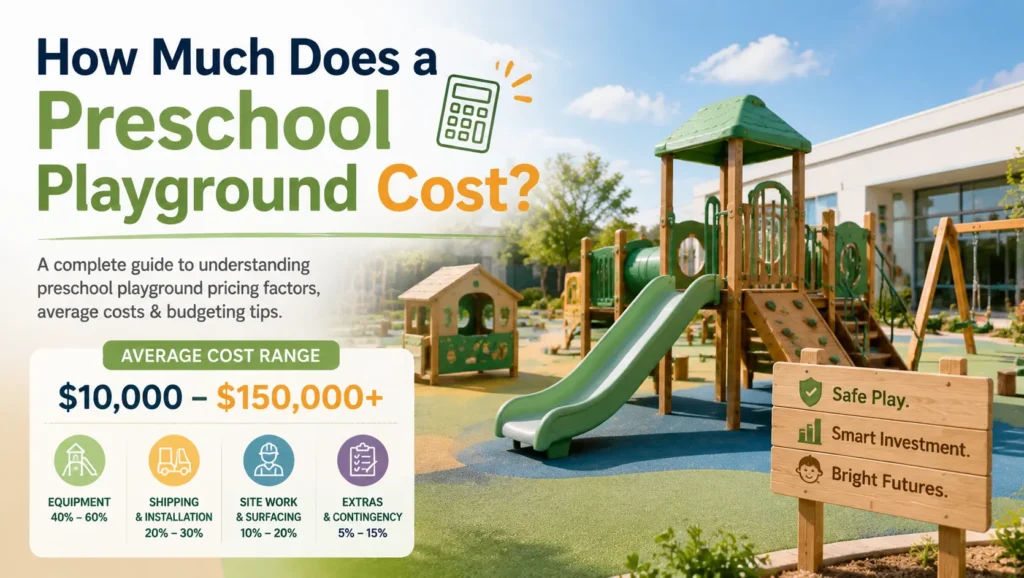
The cost of building a kindergarten playground typically ranges from $10,000 to over $150,000, with equipment being only one part of the budget. When creating a budget, costs for the site, ground, transportation, and installation should be considered simultaneously to avoid overspending later.
What Is the Average Cost of a Preschool Playground?
The average preschool playground cost usually ranges from $10,000 to more than $150,000, depending on the size of the site, equipment type, safety surfacing, installation, and site conditions.
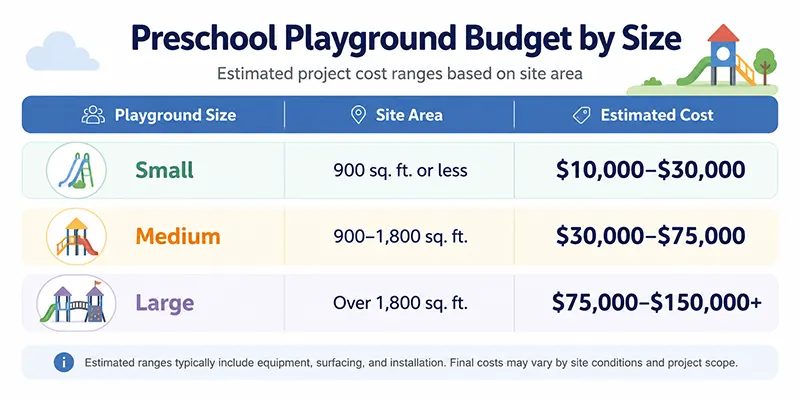
These ranges give you a practical starting point, but your final cost will depend on your site conditions, equipment choices, and installation requirements. Before setting your budget, you should measure the available area, confirm the children’s age group, and list the features you actually need. You should also ask your supplier to separate equipment, surfacing, shipping, installation, and site preparation in the quotation, so you can compare costs clearly and avoid unexpected expenses later.
What are the components of the construction cost of a kindergarten playground?
playground equipment
- Playground equipment includes slides, climbing frames, activity platforms, balance beams, interactive panels, and role-playing equipment.
- Individual units are generally cheaper than large combined units.
- Custom colors, sizes, and themes will increase the cost.
- Different age groups require different platform heights and activity levels.
Safety Surfacing
- This includes slides, climbing frames, activity platforms, balance beams, interactive panels, and role-playing equipment.
- Individual pieces of equipment are generally cheaper than large sets.
- Custom colors, sizes, and themes will increase the cost.
- Different age groups require different platform heights and activity levels of difficulty.
Install
Low equipment prices do not necessarily mean low total project costs; complex installations can significantly increase the overall budget.
Transportation and distribution
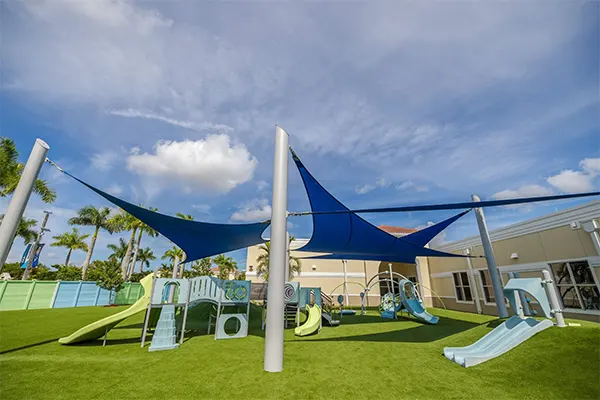
Large amusement park equipment is bulky, and transportation costs are affected by packaging volume, destination, unloading conditions, and temporary storage.
Which hidden expenses are most likely to cause budget overruns?
The equipment quote is only the starting point. Before you approve the budget, you should check what the price leaves out, because site work, surfacing, permits, storage, and maintenance can quickly increase your final cost.
Playground Size and Site Conditions
The larger your playground, the more you may spend on equipment, safety surfacing, fencing, and installation labor. You should measure the usable area carefully and check access routes, slopes, and surrounding structures before requesting a final quote.
Site Grading and Old Equipment Removal
If your site is uneven, overgrown, or already contains old equipment, you may need to pay for clearing, excavation, leveling, removal, and waste disposal. Ask your contractor to inspect the site early, rather than discovering these costs after installation begins.
Permits, Inspections, and Compliance
Local authorities may require permits, safety inspections, accessibility reviews, or final approval. You should check these requirements before placing the order, as delays can also lead to extra storage or rescheduling costs.
Safety Surfacing
Do not assume safety surfacing is included in the equipment price. Ask what material, base preparation, thickness, drainage layer, and installation work are covered in the quotation.
Temporary Storage
If the equipment arrives before the site is ready, you may need to pay for storage, additional handling, and redelivery. Confirm the construction schedule before arranging shipment.
Example of school playground budget
Imagine you are planning a 1,200 sq. ft. preschool playground for 60 children aged 3–5. The design includes slides, climbing and balance equipment, sensory panels, safety surfacing, shade, and fencing.
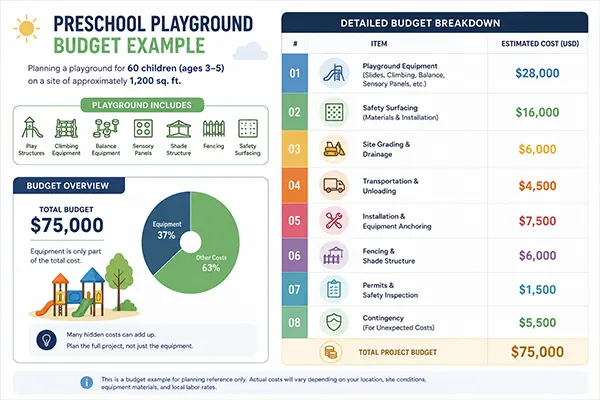
In this example, the playground equipment costs $28,000, but the total project budget reaches $75,000. The remaining $47,000 covers surfacing, site preparation, drainage, shipping, installation, fencing, inspections, and unexpected work.
This is why you should never build your budget around the equipment quote alone. Ask your supplier to list every project cost separately, so you know what is included before the equipment arrives.
This is a planning example only. Your final cost will depend on your location, site conditions, equipment choices, and local labor rates.
How to reduce the construction cost of kindergarten playgrounds?
- Prepare the venue in advance
- Completing the cleaning, leveling, pipeline verification, and drainage inspection before the supplier arrives can reduce waiting time and temporary construction costs.
- Arrange necessary equipment in advance
- When budget is limited, prioritize core activities; other themed facilities can be added in stages later.
- Climbing
- slide
- Balance exercises
- Sensory games
- social games
- When budget is limited, prioritize core activities; other themed facilities can be added in stages later.
- Choose modular playground equipment
- We recommend choosing scalable and modular equipment. You can complete the basic plan first, and then add slides, panels, or climbing components in the future according to your budget.。
- Handle appropriate work on-site
- If the local team has the necessary construction capabilities, they can undertake site clearing, removal of old equipment, or some foundation work. Equipment installation and safe ground work should not be outsourced to inexperienced personnel in an attempt to save money.
- Seeking community support
- Kindergartens can partner with parents, community organizations, or local businesses to reduce some of their costs through donations, volunteer activities, and sponsorships.
Which parts of the kindergarten playground budget should not be cut?
- The parts for which budget reduction is not recommended:
- Safe ground
- Foundation and equipment fixation
- Structural hardware
- Drainage treatment
- Safety standards
- Professional installation
- Warranty and Spare Parts
- The parts that can be appropriately controlled:
- Complex theme decoration
- Custom colors
- Repetitive game features
- Additional panels used less frequently
Equipment budgets are typically only a portion of the overall project budget. Some suppliers suggest that equipment should account for about 50%–60% of the total playground budget, with the remainder allocated to installation, ground preparation, site treatment, and ancillary facilities.
How to Get an Accurate Kindergarten Playground Quote
An effective kindergarten playground quote stems from accurate project information. Simply asking “How much?” will only yield a rough estimate from the supplier. A more detailed and precise quote is needed to better match your needs.
First, provide the site dimensions, layout plan, photos, children’s age range, expected capacity, location, and target budget. You should also mention drainage issues, existing equipment, and local safety requirements. This will help the supplier recommend more suitable equipment and plan costs reasonably.
Next, list your priorities. Differentiate between essential features (e.g., slides, climbing equipment, safety surfaces) and optional add-ons (e.g., music panels or garden areas). This helps the supplier design a feasible solution and avoids your budget being consumed by features that children may rarely use.
Request a detailed quote from the supplier, not just a total price. A complete quote should clearly list the following:
Playground equipment
Safety grounding
Transportation and unloading
Installation and securing
Site preparation and drainage
Fencing, shading, and accessories
Permits, inspections, and taxes
Before accepting a quote, carefully check for any omissions. You should also inquire about the safety standards the equipment must meet, the site preparation work that needs to be completed in advance, the responsible party for installation, and the handling of warranty claims or replacement parts.
The clearer the project description, the more accurate the quote will be. A detailed quote also helps you better compare different suppliers and reduces the risk of discovering additional costs after ordering equipment.
What should you ask the supplier before signing a contract?
We recommend retaining 6 key questions:
- What fees are not included in this quote?
- Does this include transportation, installation, and safe ground handling?
- What safety standards does the equipment meet for the project location?
- What preparations need to be made in advance for the venue?
- What should be done if the acceptance test fails?
- What is the warranty coverage and spare parts delivery cycle?
The six questions above will help you understand the true cost behind the quote. Before signing a contract, you need to know what the quote includes, what materials are required, who is responsible for installation and acceptance, and how long the supplier will provide after-sales support after delivery. Clarifying these issues early on can avoid additional costs later. Don’t hesitate to ask for details; a reliable supplier should be able to answer each of your questions patiently and clearly.
Conclusion
The real pitfall in controlling kindergarten playground construction costs isn’t choosing expensive equipment, but rather focusing solely on equipment prices in the initial budget. A more reliable approach is to first confirm site conditions and actual needs, then include equipment, construction, and ongoing operating costs in a single, comprehensive quote. This way, you’re comparing the final project cost, not a seemingly cheap quote that keeps adding extra charges later.
Top Montessoris can provide playground layout, equipment configuration, and itemized cost estimates based on your site information, children’s ages, and target budget, helping you clarify your budget before procurement and reduce rework and additional expenses.
FAQ
Does a kindergarten playground quote usually include installation?
Not necessarily. Some quotes only include equipment, while others include transportation and installation. You should ask the supplier to list the equipment, ground, transportation, installation, and site construction separately to avoid additional costs later.
What percentage of the total playground budget does equipment typically account for?
Generally, equipment accounts for about 40%–50% of the total budget. The remaining budget is usually used for safety grounds, transportation, installation, site preparation, fencing, and other ancillary works.
How Much of the Playground Budget Goes Toward Equipment and Construction?
In a typical preschool playground project, equipment accounts for about 40%–50% of the total budget. The remaining 50%–60% usually covers safety surfacing, site preparation, shipping, installation, permits, and other construction work.
Is Renovating an Existing Playground Cheaper Than Building a New One?
Not always. Removing old equipment, disposing of waste, repairing the ground, and improving drainage can all increase the cost of a playground renovation.
Is a Custom Playground Much More Expensive Than a Standard Design?
Custom playgrounds are usually more expensive because they may require additional design work, non-standard dimensions, special colors, or production adjustments. However, light customization does not always lead to a significant cost increase.
Why Do Playground Quotes Vary So Much Between Suppliers?
Price differences may come from the materials, structural thickness, hardware, safety standards, shipping methods, installation scope, and after-sales service. You should compare what each quotation includes rather than looking only at the final price.





 EN
EN  AR
AR  FR
FR  IT
IT  DE
DE  ES
ES  TH
TH  JA
JA  TR
TR