
Choosing daycare cots vs mats comes down to fit, room and daily handling: cots provide a raised sleeping surface but need accessible storage, while floor mats need clear floor space when in use and a practical place to store them. Check local rules, bedding, care and the full setup cost before ordering.
Daycare Cots vs Mats: Main Advantages And Trade-Offs
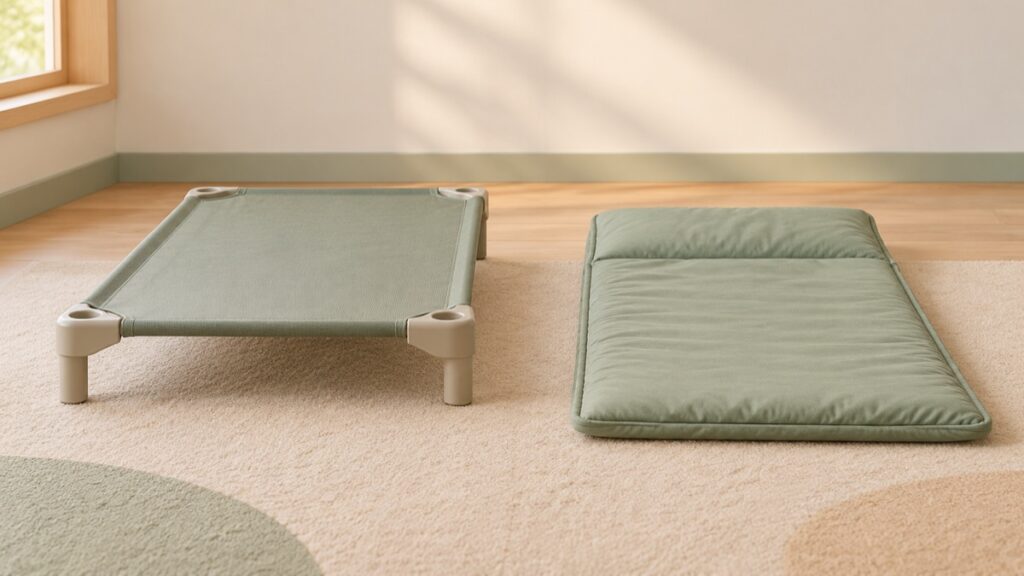
Classroom cot styles vary: some use a low frame with a taut fabric or mesh sleeping panel, while other classroom rest beds have molded sides or a slatted wood base. A floor nap mat rests directly on the floor and may lie flat, fold or roll. Here, “cot” means classroom rest equipment for children who may use it under their program’s rules—not an infant crib.
Also check what the supplier means by “nap mat.” A wipe-clean padded rest mat and a quilted fabric bedroll are different purchases. A bedroll may be bedding for a cot or floor mat rather than a standalone sleeping surface accepted by your program.
| Option | Main advantage | Main trade-off |
|---|---|---|
| Daycare cot | Raised surface; stackable models may use less storage floor space. | Requires accessible storage; a compatible trolley may be needed to move stacked cots. |
| Floor nap mat | Can be laid out individually and may fit an available shelf or rack. | Uses floor space while open; folded or rolled mats still need practical storage. |
Which Option Fits Your Classroom?
When Cots Are A Better Fit
Choose cots if a raised sleeping surface suits your program and you have space for safe, accessible storage. Stacking can reduce the storage footprint, but a stack still needs a practical handling plan.
Check the selected model’s stack height and make sure staff can reach and separate the top cot comfortably. If you use a trolley, confirm the loaded unit clears doorways and turns and has a place to park.
Cot Styles And Listed Size Examples


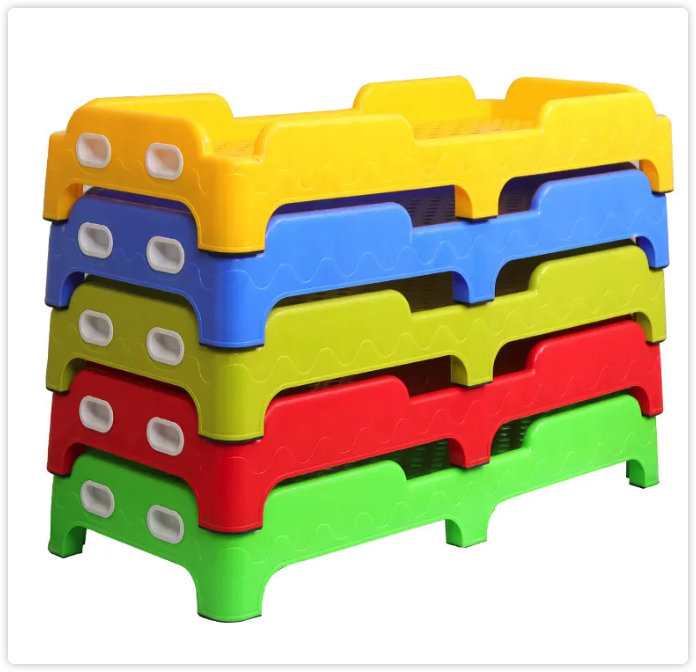

You can discuss available daycare cot options with TOP Montessoris alongside your room and storage requirements.
When Nap Mats Are A Better Fit
Floor mats can suit rooms that are cleared and reset daily, provided staff have a practical routine for laying out and collecting every mat.
Check the packed dimensions and unit weight with any permitted bedding. Make sure staff can access the rack and carry mats without dragging other items. A thick folded mat or bulky roll may need more room than its product photo suggests.
Assess the cover and padding together. Check that the surface, seams and folds suit the manufacturer’s intended use and your program’s requirements; extra softness alone does not establish suitability.
Match The Equipment to The Children
Choose the permitted equipment type before selecting dimensions or accessories. This comparison concerns children for whom your program’s rules allow classroom cots or mats. Infant sleep requires a separate equipment decision: in the United States, CPSC’s safe-sleep guidance identifies compliant cribs, bassinets, play yards and bedside sleepers as appropriate infant sleep products. A preschool cot or padded floor mat is not a substitute for those products.
For children using cots or mats, compare the usable sleeping length and width with their body size. Outer dimensions can include frame corners that do not add sleeping space. Check the product’s stated user limits, how children enter and leave it, and any individual mobility or support needs.
Your licensing authority may also set requirements for mat thickness, spacing, bedding and storage. For example, Washington’s sleep-equipment rules require floor mats designed for sleeping to be at least 1 inch thick and set minimum spacing of 18 inches on each side between floor mats, cots or mattresses. These are Washington-specific requirements, not a general U.S. standard; verify the rules for your location and service type before buying.
Measure The Room in Two States
Set Up for Naps
Measure each cot and every mat in its unfolded form, then allow for required spacing and staff access. A mat’s folded size does not show how much floor area it needs during rest time.
Mark the proposed positions on a room plan or test a small area with the actual equipment. Keep access to exits, doors and necessary facilities clear, and check how staff will reach each child. Include fixed cupboards and furniture that will remain in the room during rest time.
A storage-friendly product can still be the wrong choice if the complete nap arrangement blocks circulation. Resolve that layout before ordering the full quantity.
Packed Away for Learning
Measure the whole storage setup: its footprint, loaded height and the space staff need to take equipment in and out. For cots, ask for the measured height of your intended stack, including the trolley if one is used. Single-cot height does not reveal how closely the frames nest.
For mats, check folded or rolled dimensions against the actual rack openings and shelf depth. Include separate bedding storage where needed. Equipment should be dry before it is packed away, and the arrangement should protect sleeping surfaces from floor-contact surfaces and other children’s bedding as your rules require.

Storage planning illustration, not to scale. Stack capacity, rack design and clearances must match the selected equipment and your program’s requirements.
Walk the route between the nap area and storage. Check doorway width, turns, thresholds and trolley parking. If staff would need to move other classroom furniture, choose a different storage location.
Compare Cleaning And Bedding as One Routine
Neither equipment type is automatically the more hygienic choice. Raised cots reduce direct contact between the sleeping surface and the floor, but frames, fabric and bedding still need care. Mats require attention to both sides, especially when folding or storing them could bring the floor-contact side against the sleeping surface.
Match your cleaning process to the equipment’s care instructions and local requirements. CDC’s guidance for early care and education settings distinguishes cleaning from sanitizing and disinfecting. It advises cleaning first and following product-label instructions, including the required disinfectant contact time. A quick spray and immediate wipe may not complete that process.
Include bedding in the daily plan. Decide how each child’s equipment and bedding will be identified, where used linen will go, and how spare bedding will be kept ready. Check that each sheet fits its intended cot or mat without distorting a mat or interfering with cot stacking points. Coordinate nap bedding and supplies with the equipment rather than treating them as an afterthought.
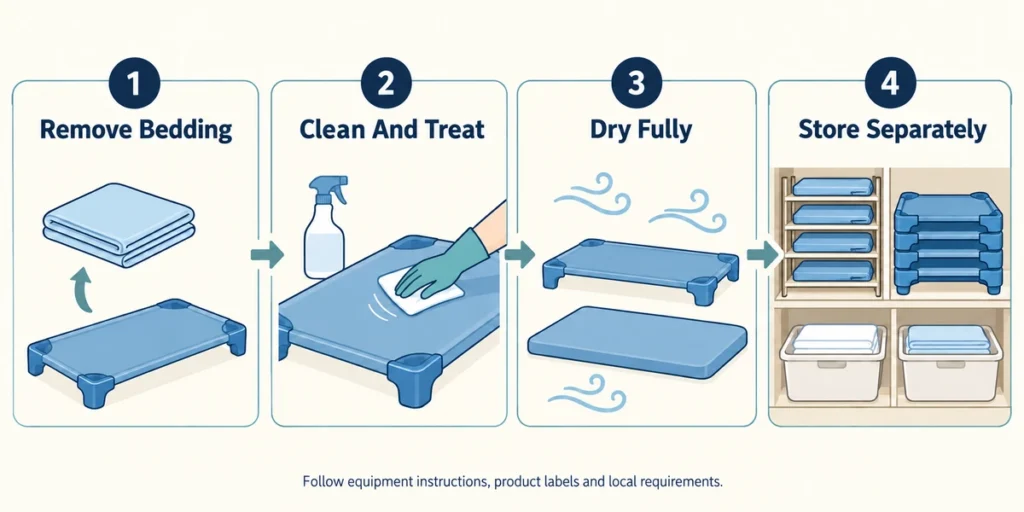
Care-routine illustration: remove bedding, clean and dry equipment before storage. Follow the product label and local rules for any sanitizing or disinfecting.
During routine checks, look for damaged covers, exposed padding, loose fabric, broken corners or unstable frames. Remove damaged equipment from use and follow the manufacturer’s repair or replacement instructions. Availability of replacement covers or parts can make a practical difference over the life of the classroom set.
Compare The Full Cost of A Classroom Set
Compare quotations for the same number of usable sleeping places and the same included items. A cot-only price and a mat-plus-bedding price are not equivalent. The total should include the equipment, required bedding, storage racks or trolleys, delivery and any assembly costs.
Then consider recurring costs: laundry, replacement bedding, repair parts and staff time for setup, cleaning and pack-away. A lower initial quote may be less attractive if it requires extra storage furniture or makes the daily routine difficult. Conversely, a more expensive frame does not guarantee a longer useful life; construction, care, warranty terms and parts availability all matter.
Before choosing a supplier, get clear answers to four questions:
- What are the usable sleeping dimensions, outer dimensions and stored dimensions of the exact model?
- Which sheets, covers, trolley or rack are included and compatible?
- Which care instructions and user limits apply, and which safety or compliance documents cover this model and target market?
- What are the delivery terms, warranty coverage and replacement-part arrangements?
If you are replacing part of an existing set, include compatibility in the comparison. Keeping one bedding size or storage system may simplify operations, provided the new equipment genuinely fits it. Where a sample is practical, use it to check the fit and handling before committing to a large order.
SSS
Can You Put A Nap Mat on A Cot?
Only use an additional mat or topper if the cot and bedding manufacturers permit that combination. Check fit, attachment and user limits. A separate pad can change how the sleeping surface behaves and may interfere with storage. Adding padding is not automatically an improvement.
Can You Mix Different Cot Brands in One Stack?
Do not assume that frames with similar dimensions will nest safely. Corner shapes, stacking points and trolley compatibility can differ. Ask the supplier to confirm compatibility with your existing model; otherwise, plan separate storage for the new set.
Should Families Provide Their Own Bedding?
Either arrangement can work if your program defines the acceptable bedding, labeling, laundering and replacement process. Give families clear size and care requirements, and keep suitable spares for missing or soiled items. Check that any bedding brought from home fits the equipment and your program’s rules.
Choose The Rest System That Fits Your Day
Choose cots when the raised surface and a workable stacking system suit your classroom. Choose mats when the permitted design fits your room changes and storage arrangement. In both cases, assess the children’s fit, the complete nap layout and the daily care routine together.
To discuss a classroom purchase, contact TOP Montessoris with the children’s age groups, required quantity, room plan and available storage dimensions. Those details help narrow the cot, bedding and storage options for a useful quotation.





 TR
 EN
 AR
 FR
 IT
 DE
 ES
 TH
 JA