
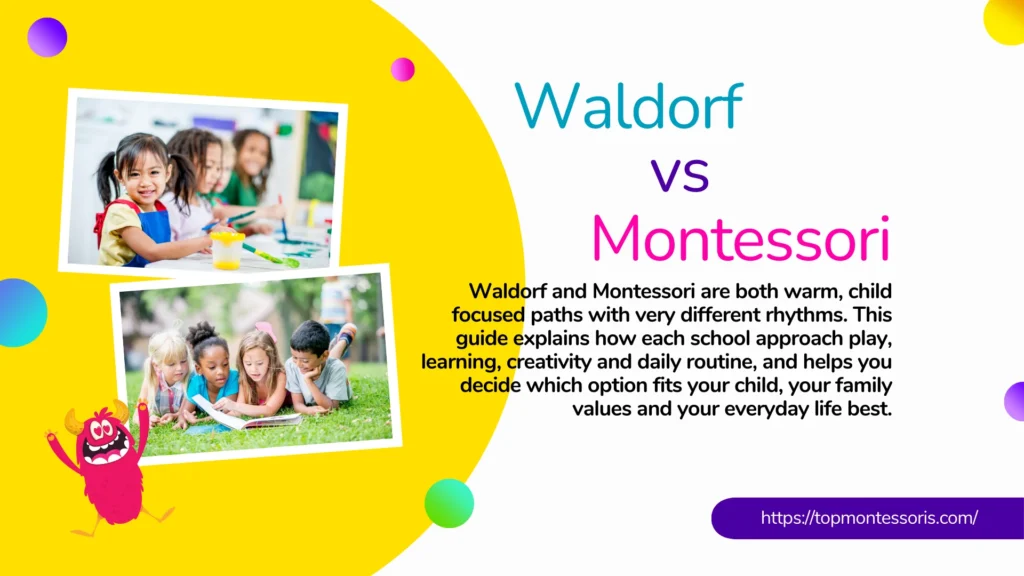
Choosing the right educational path is one of the most significant decisions a parent makes. When looking beyond traditional public schooling, two names consistently dominate the conversation: Waldorf and Montessori. Both philosophies are renowned for respecting the child as an individual and prioritizing holistic development over rote memorization, yet they take vastly different routes to achieve these goals.
The distinction lies in their fundamental view of childhood. Montessori is grounded in reality, offering children functional tools and early academic opportunities to foster independence and logic. In contrast, Waldorf protects the magic of childhood through fantasy, strictly delaying formal academics in favor of storytelling, artistic expression, and imagination-based play.
These philosophical differences shape everything from the toys on the shelves to the daily rhythm of the class. While a Montessori environment functions like a quiet, organized workshop for individual discovery, a Waldorf classroom feels like a warm, communal home focused on group activities. Understanding these unique approaches is the first step in finding the environment where your child will truly thrive.
Many of the world’s most creative people credit their non-traditional education for their success. Larry Page & Sergey Brin (Founders of Google) credit Montessori for their independence and willingness to think differently. Meanwhile, Jennifer Aniston (Actress) attended a Waldorf school, known for fostering the artistic versatility she is famous for.
What Is Montessori?
The Montessori approach to education is a child-centered method developed to foster independence, critical thinking, and a love for learning. In a Montessori classroom, the emphasis is placed on self-directed activity, hands-on learning, and collaborative play.
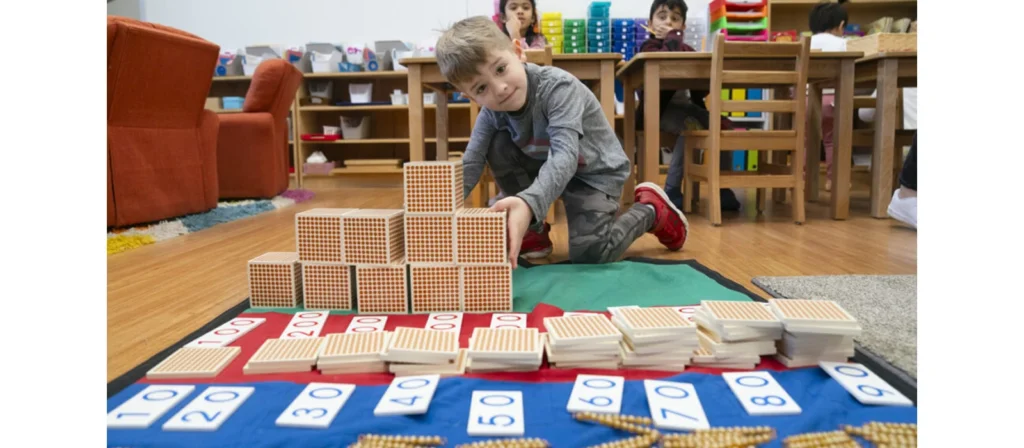
Unlike traditional classrooms where the teacher stands at the front delivering lessons to the whole group, Montessori views the child as the leader of their own learning journey. The core belief is that children are naturally eager for knowledge and capable of initiating learning in a supportive, scientifically prepared environment.
Key Characteristics of Montessori:
- Child-Led Learning: Students choose their activities from a prescribed range of options and work at their own pace.
- The Prepared Environment: Classrooms are meticulously organized with accessible materials that encourage exploration and order.
- Focus on Reality: Early learning is grounded in the real world (e.g., washing dishes, counting beads) rather than fantasy or pretend play.
- Independence: The ultimate goal is to help the child do it themselves, building confidence and practical life skills from a young age.
What Is Waldorf?
Waldorf education (also known as Steiner education) is a humanistic approach based on the educational philosophy of Rudolf Steiner. While Montessori focuses on the development of the intellect through concrete tasks, Waldorf emphasizes the development of the child’s spirit, imagination, and artistic sensibilities.

The primary goal of a Waldorf school is to educate the “whole child”—the head, the heart, and the hands. It strives to cultivate free-thinking, socially responsible, and emotionally balanced individuals. In the early years, the Waldorf method is fiercely protective of childhood, believing that creative play and a strong connection to nature are more vital than early academic achievement.
Key Characteristics of Waldorf:
- Imagination-Based Learning: For young children, learning is driven by storytelling, myth, and fantasy rather than factual textbooks.
- Delayed Academics: Formal reading, writing, and math are typically not introduced until age seven (First Grade), allowing preschoolers to focus purely on play and social development.
- Arts and Crafts: The curriculum is deeply infused with arts, music, knitting, gardening, and movement (Eurythmy).
- Rhythm and Routine: Days follow a predictable, comforting rhythm of expansion (energetic play) and contraction (focused circle time or storytelling).
The Origin of Montessori and Waldorf Schools
The History of Montessori Education
The Montessori method began in Italy in 1907 when Dr. Maria Montessori opened the first “Casa dei Bambini” or “Children’s House” in a working-class neighborhood in Rome. Dr. Montessori, one of the first female physicians in Italy, had studied child psychology and special education, and she believed that children learn best in environments that support their natural development.

Her approach was revolutionary for the time. Instead of forcing children to memorize facts, she observed how they interacted with their surroundings and developed a method that allowed them to explore freely using hands-on materials. The success of her first school spread quickly across Europe and beyond, attracting educators who wanted a more humane and child-centered alternative to traditional schooling.
Montessori’s philosophy emphasized independence, concentration, and self-discipline. Her ideas gained international attention, and by the 1920s and 1930s, Montessori schools had opened in countries around the world. Despite facing setbacks during wartime, the movement regained momentum in the mid-20th century and continues to expand globally today.
The History of Waldorf Education
Waldorf education was established in 1919 in Stuttgart, Germany, when industrialist Emil Molt asked philosopher Rudolf Steiner to create a school for the children of workers at the Waldorf-Astoria cigarette factory. Steiner, who was known for his spiritual philosophy called anthroposophy, accepted the request and developed a new educational model based on his beliefs about human development.
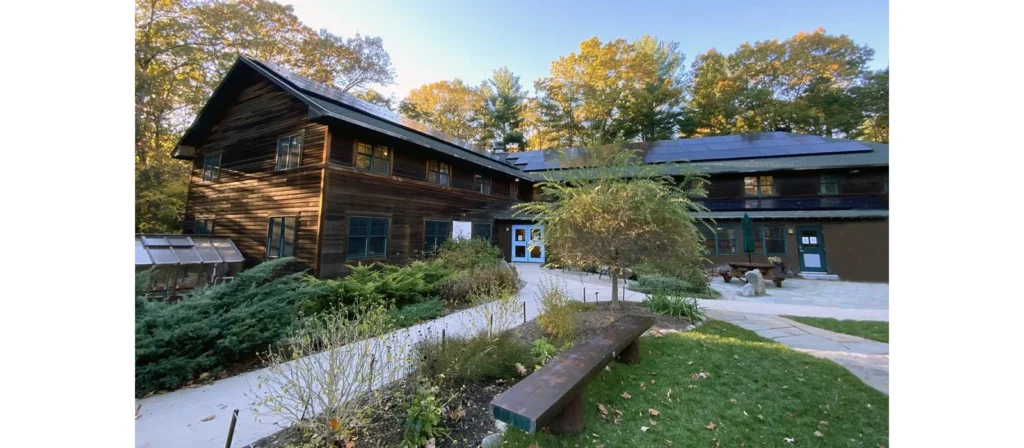
The first Waldorf school opened with a focus on educating the whole child through a balance of intellectual, artistic, and practical activities. Steiner emphasized the importance of imagination, rhythm, and moral education in early childhood. He believed that learning should unfold naturally according to the child’s developmental stage, with minimal academic instruction in the early years and a strong emphasis on storytelling, movement, and the arts.
Waldorf education quickly spread through Europe and later to North America, especially after World War II. It found a strong following among parents and teachers looking for an alternative to rigid academic systems. Today, there are over 1,000 Waldorf schools worldwide, and the method is still guided by Steiner’s original principles.
Montessori vs. Waldorf Philosophy
Montessori Philosophy
The Montessori philosophy is grounded in the idea that children are naturally driven to learn and that they thrive when given the freedom to explore within a well-structured environment. Dr. Maria Montessori believed that education should support the child’s natural development rather than impose a fixed curriculum or timeline.

In Montessori schools, the focus is on independence, order, and self-discipline. Children are seen as capable individuals who can make meaningful choices about what and how they learn. The learning process is self-directed, and the teacher acts as a guide, observing each child’s needs and providing the right materials at the right time.
Montessori emphasizes learning through the senses and real-life activities. The approach avoids fantasy and abstract concepts in early childhood, preferring concrete experiences that help children understand the real world. There is also a strong focus on intrinsic motivation. Instead of external rewards like grades or praise, children are encouraged to find satisfaction in the learning process itself.
Overall, the Montessori philosophy promotes independence, concentration, and respect for the child’s individuality. It seeks to build strong, self-motivated learners who can think critically and act responsibly.
Waldorf Philosophy
The Waldorf philosophy, inspired by Rudolf Steiner’s spiritual view of human development, takes a more artistic and imaginative approach to education. It sees childhood as a time for nurturing creativity, emotional growth, and a connection to the natural world before introducing academic learning.
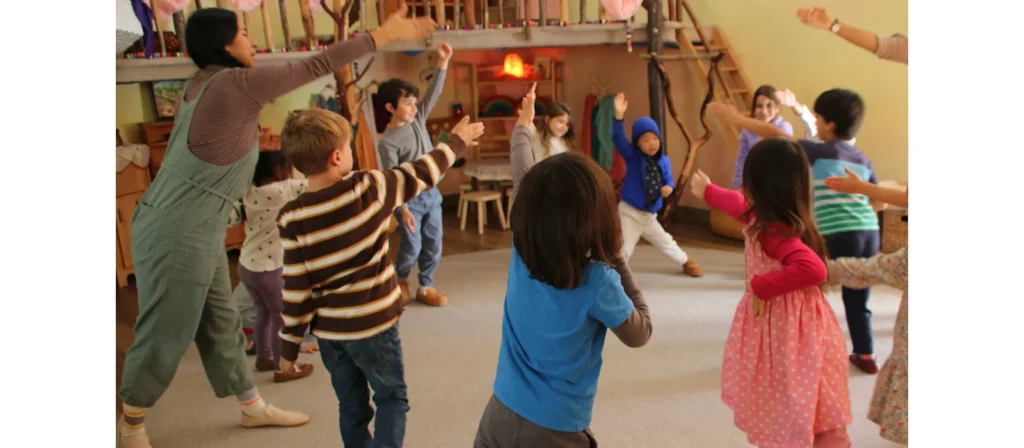
In early childhood, Waldorf education emphasizes play, rhythm, and imitation. Children learn through movement, storytelling, and practical activities such as cooking, crafting, and gardening. Formal academics are delayed until around age seven, when Steiner believed children become ready for more abstract thinking.
Waldorf schools place high importance on imagination and creativity. Unlike Montessori, Waldorf actively encourages fantasy, fairy tales, and myth as tools for emotional and moral development. Teachers are viewed as central figures who lead the class through a carefully planned journey of learning, often staying with the same group of students for several years.
Another key belief in Waldorf philosophy is that education should unfold gradually, with each stage of learning aligned to the child’s emotional and physical development. The curriculum is designed to speak to the “head, heart, and hands,” fostering intellectual, artistic, and practical skills in equal measure.
See Our Recent Work: Designing Modern Kindergartens
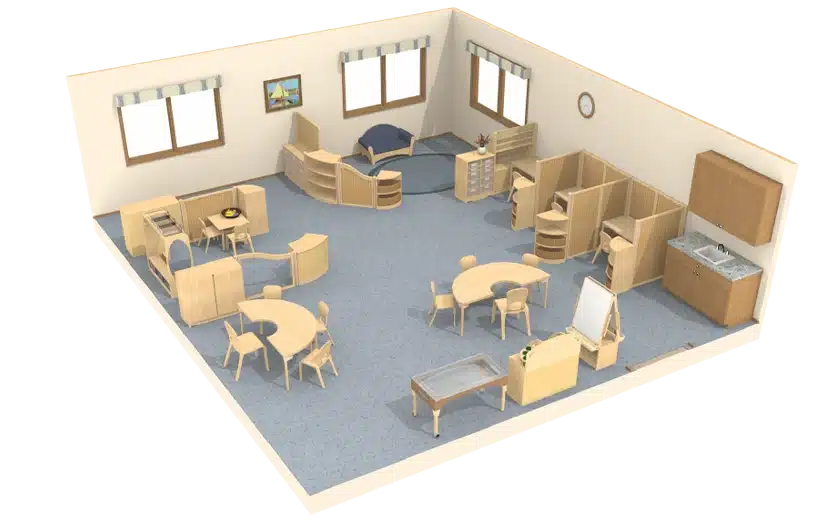
We don’t just discuss educational theories; we build them. We have recently partnered with multiple schools to design and furnish stunning Montessori and Reggio-inspired learning spaces. Browse our Projects to see how we help kindergartens transform empty rooms into world-class educational environments.
 View Our Recent Projects
Philosophy & Core Differences: Montessori vs Waldorf
At first glance, both philosophies seem similar because they respect the child and avoid high-pressure testing. However, they hold fundamentally different views on how children perceive the world.
Reality vs. Fantasy
This is the most significant conflict between the two methods. It dictates how children play and what stories they hear.
Montessori: Grounded in Reality Montessori education is rooted in the real world. Dr. Montessori believed that young children under the age of six are desperate to understand their actual surroundings.

- Does Montessori encourage pretend play? Generally, no. The method distinguishes between “work” and “play.” It assumes a child prefers baking a real cake or washing real dishes over pretending to do so with plastic toys.
- The classroom focuses on tangible, functional tasks rather than myths or talking animals.
Waldorf: Grounded in Fantasy Waldorf education protects the magic of childhood. It views early childhood as a dream-like phase where imagination should reign supreme.
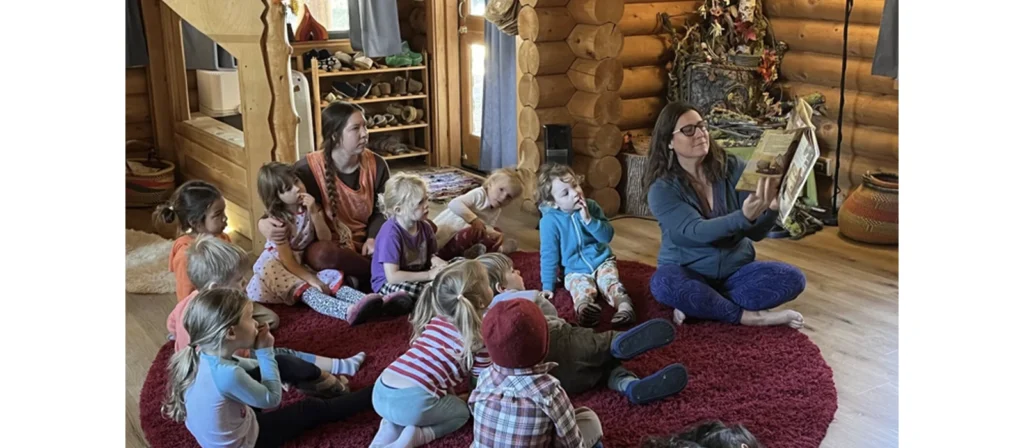
- Play is considered the serious work of childhood.
- The curriculum relies heavily on storytelling, fairy tales, and mythology. Teachers encourage children to live in a world of make-believe to foster creative thinking.
The Timeline for Academics
The two schools differ drastically on when a child should start formal learning like reading and math.
Montessori: Follow the Child
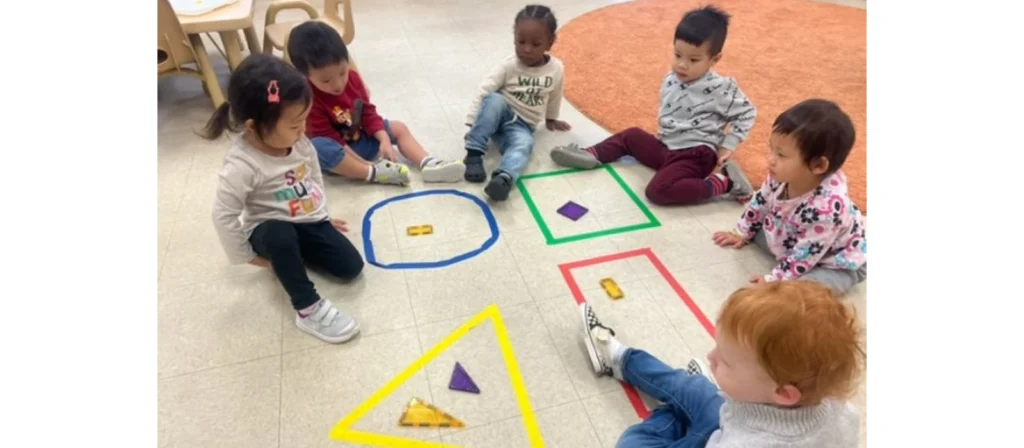
- Academics are introduced early, often as young as age three or four.
- There is no rigid schedule. If a child shows “readiness” and interest in reading, they are given the materials to learn immediately.
- The focus is on the “mathematical mind” and order.
Waldorf: Delay Until Seven
- Formal academics are strictly delayed until First Grade, or approximately age seven.
- Waldorf educators believe that pushing intellectual content too early creates stress and stunts emotional growth.
- The early years are reserved exclusively for social development, artistic play, and physical movement.
Scientific vs. Spiritual
Montessori views the child through a scientific lens.
- The method focuses on cognitive development, brain growth, and observation.
- The goal is to help the child adapt to the real world and become independent.
Waldorf views the child through a spiritual lens.
- The method focuses on the soul and spirit.
- The goal is to nurture the whole being (head, heart, and hands) and connect the child to the rhythms of nature and the universe.
Practice Differences: Montessori vs. Waldorf
While the philosophies are abstract, the daily experience for a child in these schools looks very different. From the toys on the shelves to the way the day is scheduled, here is how the two methods compare in practice.
Classroom Environment & Materials
The physical space is the first thing you notice when walking into these schools.
Montessori: The Prepared Environment A Montessori classroom feels like a quiet workshop or a laboratory. It is minimalist, orderly, and designed for independent work.
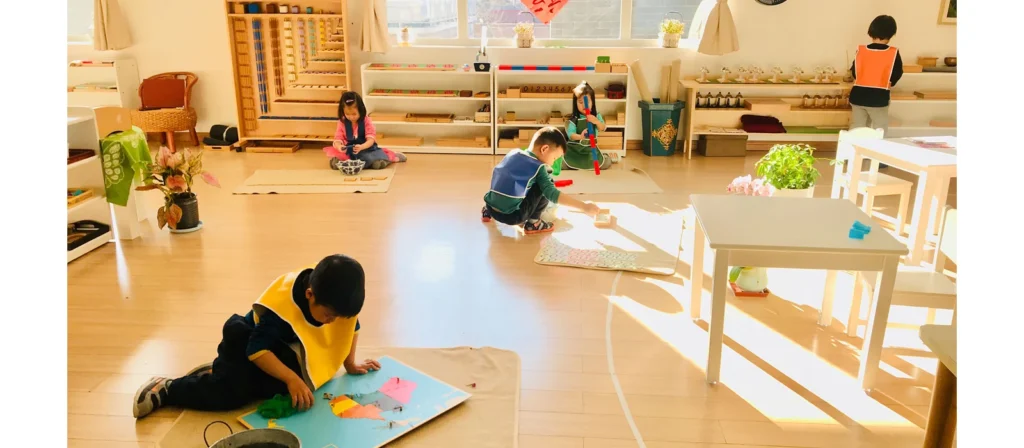
- Materials Used: The room is filled with specific, standardized “works” or materials (like the Pink Tower or Moveable Alphabet). These are self-correcting, meaning the child can see their own mistake without a teacher pointing it out.
- Decentralized Learning: There are no rows of desks. Instead, learning is decentralized. Children spread out on small floor rugs or low tables to work alone or in pairs.
- Aesthetic: The focus is on natural light, cleanliness, and functionality.
Waldorf: The Homelike Haven A Waldorf classroom feels like a warm, cozy living room. It is designed to be a sensory-rich extension of the home.
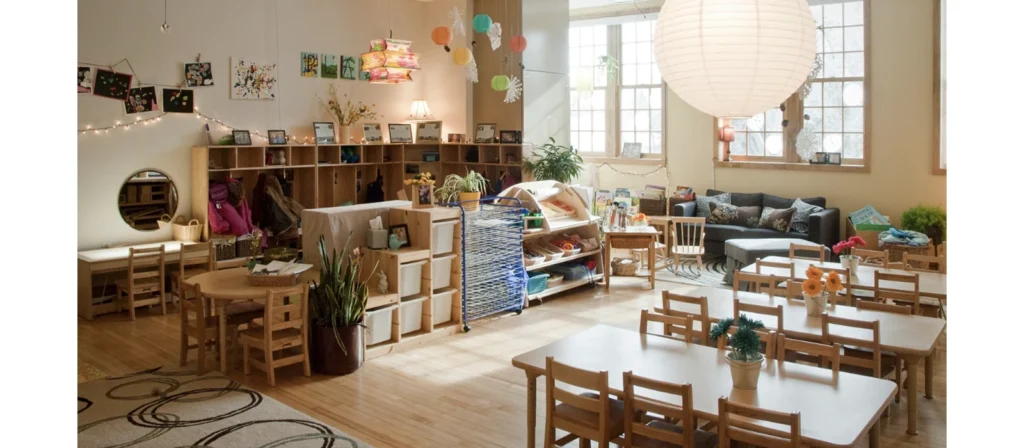
- Materials Used: You will see baskets of pinecones, seashells, silk cloths, and wooden blocks. Toys are open-ended to spark creativity. For example, a simple piece of wood can become a phone, a car, or a sandwich.
- Aesthetic: The walls are often painted in soft, calming colors (like peach or pink). The lighting is warm, and the furniture is made of natural wood.
The Role of the Teacher
The teacher’s behavior is one of the starkest contrasts between the two styles.
Montessori: The Silent Guide
- The teacher is often called a “Guide” or “Directress.”
- Their role is unobtrusive. They observe the children from a distance and step in only to introduce a new material or help if a child is struggling.
- They do not stand at the front of the room lecturing. The “teacher” is actually the environment itself; the adult is just the link between the child and the materials.

Waldorf: The Artistic Leader
- The teacher is the central figure and leader of the classroom.
- In Waldorf grade schools (ages 7-14), the teacher often stays with the same class of students for up to eight years. This creates a deep, long-term bond.
- The teacher leads through performance: storytelling, singing, and modeling artistic activities that the children mimic.

Age Grouping and Social Structure
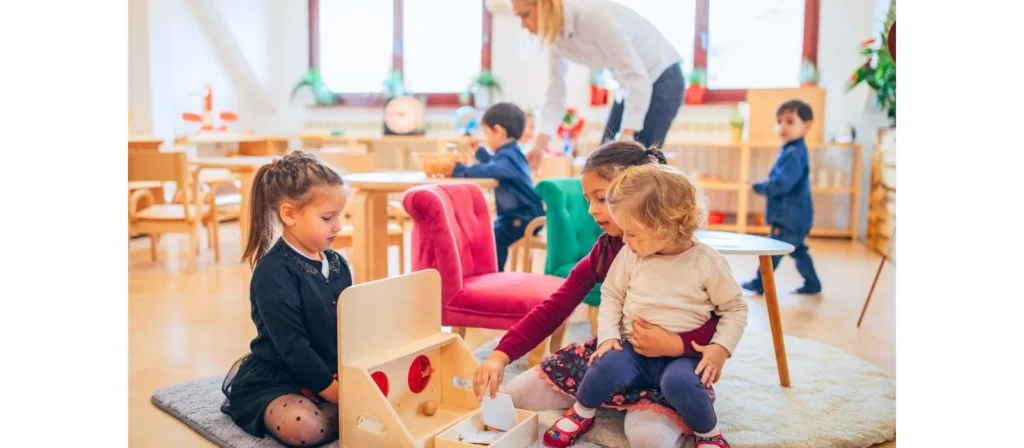
How do Montessori schools group children? Montessori relies on mixed-age grouping, typically in three-year cycles (e.g., ages 3–6, 6–9, 9–12).
- This allows older children to reinforce their learning by teaching the younger ones.
- Younger children look up to the older students as role models.
- It mimics a family structure where siblings of different ages interact.
How do Waldorf schools group children? Waldorf typically uses same-age grouping for grade school (Grade 1, Grade 2, etc.), similar to traditional schools.
- The goal is for the class to move through developmental stages together as a social unit.
- However, in early childhood (kindergarten), Waldorf classes are often mixed-age (ages 3–6), similar to Montessori.
Student Freedom and Routine
How much freedom do Montessori students have? Montessori students have a high degree of autonomy.
- Choice: The child chooses what to work on, where to sit, and how long to engage with a task.
- Movement: They are free to move around the room as they please.
- Structure: The freedom is within limits. They must respect the materials and their peers. The “schedule” is largely determined by the child’s own workflow.
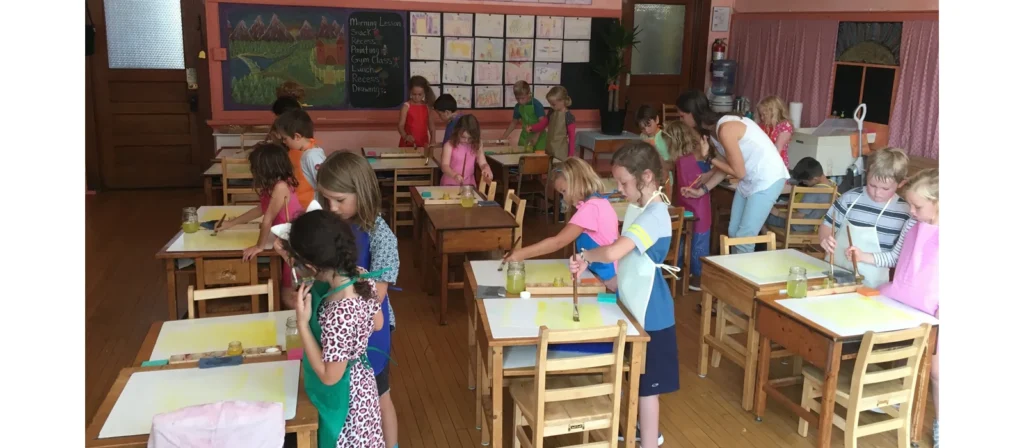
Waldorf: Freedom in Play, Structure in Rhythm Waldorf is more teacher-directed regarding the daily schedule.
- Rhythm: The whole class moves together through the day’s activities (e.g., everyone paints at the same time, everyone eats at the same time).
- Play: Freedom is found in the dedicated “free play” periods, where children can use their imagination without adult interference. However, the overall flow of the day is orchestrated by the teacher.
Pros, Cons & Suitability
No educational method is one-size-fits-all. While both Montessori and Waldorf prioritize the child’s needs, they suit very different personality types and family values. To help you decide which path aligns best with your child, here is a quick breakdown of the key strengths, challenges, and suitability for each style.
| Feature | Montessori | Waldorf |
| Best Fit For… | Independent, analytical children who enjoy order and working alone. | Imaginative, artistic children who thrive in group settings and storytelling. |
| Academic Approach | Early Start: Academics (reading/math) introduced from age 3 based on interest. | Delayed Start: No formal academics until 1st Grade (age 7). Focus is on play. |
| Classroom Focus | Reality & Function: Real tools, practical life skills, and specific learning materials. | Fantasy & Arts: Open-ended toys, fairy tales, music, and nature-based play. |
| Teacher’s Role | The Guide: A background observer who facilitates independent learning. | The Leader: A central figure who directs the class through stories and rhythm. |
| Potential Challenge | Can feel too rigid for children who crave high-energy, imaginative role-play. | Delayed reading can cause anxiety; strict limits on technology may be hard for some families. |
Conclusion
Ultimately, the debate between Waldorf and Montessori isn’t about which method is “better”—it is about which one is the right fit for your specific child and your family’s lifestyle.
Both philosophies offer a refreshing alternative to traditional, rote-learning education. They both respect the child’s individuality and aim to raise curious, capable human beings. The choice comes down to what you value most right now:
- If you value independence, early life skills, and a scientifically structured environment, Montessori is likely the better match.
- If you value imagination, a slow-paced childhood, and artistic expression, Waldorf may be the perfect home for your child.
The Best Way to Decide? Reading about these schools is helpful, but seeing them in action is essential. Schedule a tour at both a local Montessori and a Waldorf school. Watch the children: Do they look happy? Do they seem engaged? Often, you will walk into a classroom and simply “feel” that it is the right place for your child. Trust that instinct.





 EN
EN  AR
AR  FR
FR  IT
IT  DE
DE  ES
ES  TH
TH  JA
JA  TR
TR