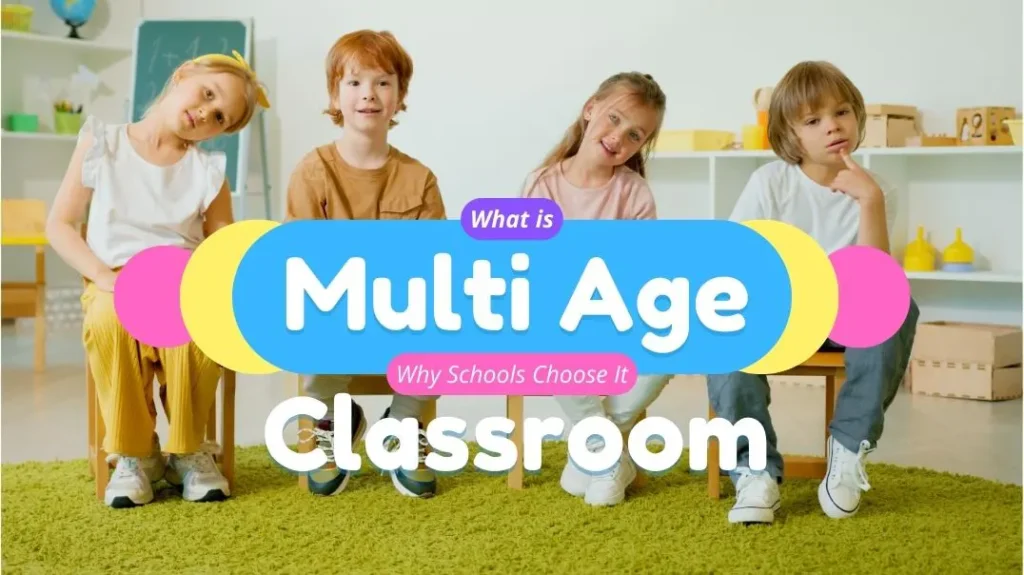
A multi age classroom (also called a mixed age classroom) is a classroom structure where children of different ages learn together in one learning environment. Instead of everyone being the same age, the group includes an intentional age span, common in early childhood education and also seen in some elementary programs.
If you work in early childhood education, you’re probably well aware that traditional single-age classes aren’t always suitable for all children. Some children progress rapidly, while others need more time, and “peer average” seems to become a constantly shifting goal. Meanwhile, terms like multi-age classes or mixed-age classes have become popular, but how they actually function in everyday classroom life isn’t always clear.
A well-designed multi-age class offers a different developmental path. It’s no longer organized around a child’s birth year, but rather based on how the child has actually developed over several years, shaping the environment, teaching methods, and furniture accordingly. In this article, we’ll delve into what multi-age classes truly mean, how they differ from single-age classes, how they manifest in different types of schools, and how appropriate classroom design and furniture can support children.
What Is a Multi Age Classroom
A multi age classroom is a learning space where children of different ages or grade levels share the same room, the same teaching team, and the same daily routine. Instead of putting all four-year-olds together and all five-year-olds together, a multi age classroom might mix three-, four-, and five-year-olds in one mixed age classroom community. The focus shifts from “What year were you born?” to “What are you ready to learn right now?”
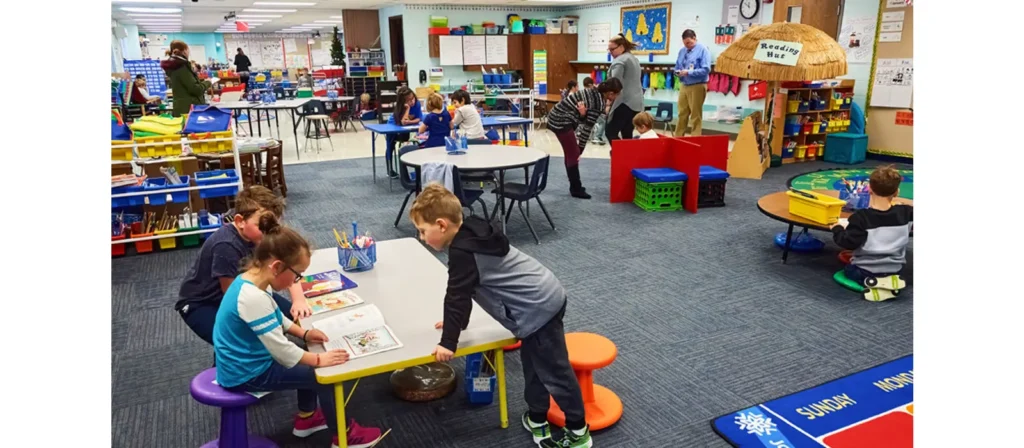
In early childhood education, this classroom structure is designed very intentionally. Teachers plan the learning environment so that younger children can safely try things that are just a bit challenging, while older children can deepen their skills and take on leadership roles. The room, the materials, and the daily flow are all set up so children can work at their own level, side by side, instead of being pushed to match a fixed “average” for their age.
Think of a multi age classroom as a long-term learning community rather than a one-year stop. Children usually stay with the same class for more than one year, which helps them build strong relationships with teachers and peers. Over time, they move from being the youngest, who look up to others, to becoming the “big kids” who model routines, language, and problem-solving. This steady, connected learning environment is one of the biggest reasons schools are paying more attention to the multi age classroom model.
Typical Multi Age Groupings
In a multi age classroom, schools usually work with an age span of about two to three years. For example, an early childhood program might group ages 3–5 together, or a preschool might have a mixed age classroom with 4–6-year-olds. This kind of multi age grouping is wide enough for real peer learning to happen, but not so wide that the gap in physical and emotional development becomes overwhelming for teachers or kids.
You’ll also see age span classrooms in the early grades of elementary school, like a combined Grade 1–2, or sometimes a 2–3 class. In these settings, the teacher designs projects and routines that can stretch up or down in difficulty, so younger students can join in meaningfully while older students get room to deepen and extend their thinking. Instead of constantly reshuffling groups by age, the class stays together as one mixed age community, and the learning adjusts around them.
The specific grouping method largely depends on local conditions. Some schools maintain the same age groups year after year, while others continuously adjust the division of mixed-age classes based on the actual situation of their children and teachers.
Why Schools Are Moving Away From Single-Age Classrooms
Many schools are rethinking the traditional age-based classroom model because it no longer fits how children actually learn, or how schools actually operate. In early childhood education, especially, rigid age grouping can limit flexibility, strain resources, and overlook individual development. Multi age classrooms offer an alternative classroom structure that better reflects real learning patterns, enrollment realities, and modern expectations around individualized learning.
Rather than seeing age-based classrooms as the default and everything else as unusual, many leaders now view mixed-age setups as a practical way to support individualized learning, stabilize enrollment, and give teachers more options when group sizes and child needs change from year to year.

Limitations of Traditional Age-Based Classrooms
A single-age classroom assumes that children of the same age are ready for the same skills at the same time. In practice, this rarely holds. Developmental differences in language, self-regulation, motor skills, and attention span can be wide, even within a few months.
Teachers in age-based classrooms often spend significant time adjusting lessons for children who are either ahead or behind the expected level. This can lead to frustration for students and increased workload for educators. The learning environment becomes centered on managing gaps rather than supporting natural progress.
Because age-based classrooms are organized around a fixed curriculum first and individual needs second, it’s harder to give each child what they really need. Differentiation is possible, of course, but it often feels like an add-on instead of the core plan. Over time, this can create labels like “ahead” or “behind” that stick with children longer than they should, instead of recognizing that development is naturally uneven and dynamic.
Changing Needs in Modern Early Education
Modern early childhood education is moving toward social-emotional skills, problem-solving, and collaboration, not just rote academics. Families and educators want children who can think, communicate, and work with others, not just memorise facts. In this new landscape, rigid age-based classrooms can feel out of step.
A multi age classroom lines up more naturally with these newer early education trends. Mixed-age groups give children built-in chances to help, lead, imitate, negotiate, and practice empathy every day. Teachers can design activities with broad entry points so each child participates at their own level, which makes individualized learning part of the basic design, not an exception. Instead of constantly racing to “keep up with the grade,” children are supported to move forward from where they actually are.
Able to recruit students stably
Beyond pedagogy, there are operational reasons schools move away from age-based classrooms. Enrollment rarely arrives in perfect age blocks. Mid-year enrollments, sibling placement, and local demographic shifts can disrupt single-age models.
Multi age grouping provides more stability. Classrooms can absorb enrollment changes without constant reshuffling, and staffing can remain more consistent. Teachers build longer-term relationships with children, and the classroom structure adapts more smoothly to real-world conditions.
Key Benefits of a Multi Age Classroom
When a multi age classroom is set up on purpose, it can do some very cool things for kids’ growth. Instead of everyone being the same age and pushed through the same steps, children move at their own pace, learn from each other, and build a strong sense of “this is our class.” Below are some simple, concrete ways this kind of mixed age classroom helps.
Younger Children Get Role Models
In a multi age classroom, younger kids don’t just learn from adults, they also watch “big kids” all day long. They copy how older children talk, share, line up, solve problems, and even how they calm down after being upset. This kind of peer learning makes social development feel very natural and less forced.
It Helps Cultivate Children’s Willingness to Help Others.
For older children, mixed-age classes give them daily opportunities to help their less experienced peers. They might show younger friends how to arrange building blocks, read simple picture books together, or spend time with them during snack time. These small acts foster leadership, empathy, and self-confidence in children without turning them into “little teachers.”
Companionship Outside the Classroom
Because of their mixed ages, the children constantly learn from each other, how to try new puzzles, how to build taller block towers, and how to participate in games in a friendly manner. This peer learning is not a special activity, but rather integrated into all aspects of daily life. This continuous interaction helps children’s social and cognitive abilities develop simultaneously.
More Flexible Activities
In mixed-age classes, teachers design tasks whose difficulty can be adjusted as needed, using the same materials. For example, one child might be counting, while another child might be doing sorting, pattern recognition, or addition using the same materials. This is the practice of differentiated instruction, where children learn according to their own level without feeling discriminated against.
Reducing Children’s Stress
Because the class is mixed-age, it’s difficult to distinguish who is “older,” “younger,” “progressing faster,” or “progressing slower.” Children are simply at different developmental stages, which is normal. In this environment, the advantage of mixed-age classes is that they reduce comparisons and labeling, focusing more on “What do you need next?” rather than “Are you keeping up with the grade level?”
Strong Relationships and Stable Routines Over Time
Many multi age classrooms keep children with the same teacher and peer group for two or more years. This creates real learning continuity. Kids don’t have to start from zero every year with new adults and new classmates. Teachers know each child deeply, routines feel familiar, and friendships have time to grow. That stability makes it easier for children to relax, take risks, and keep building both academic skills and social confidence.
Multi Age Classroom vs Single Age Classroom
When people compare mixed-age classes and single-age classes, they are essentially asking what daily learning life is like for real children in a real classroom. One model puts children of different ages in the same mixed-age class, while the other keeps all children in the same age group. Both models can work, but they differ significantly in terms of pace, teacher-student relationships, and flexibility. Here is a concise overview to help you easily understand the differences.
| 側面 | Multi Age Classroom | Single Age Classroom |
|---|---|---|
| Age mix | Different ages in one group | Same age or same grade only |
| Learning pace | Kids work at their own level | One main pace for the whole class |
| Peer learning | Older help younger; lots of role models | Mostly same-age friends learning together |
| Teacher planning | More levels in each activity | One level with small adjustments |
| Relationships | Children stay together for several years | New teacher and class every year |
| 柔軟性 | Easier to handle changing enrollment | Harder to adjust when numbers shift |
| Overall feel | Long-term “learning family” vibe | Clear, familiar grade-by-grade setup |
How Multi Age Classrooms Differ by School Type
The core concept of multi age classroom remains the same regardless of the circumstances. Children of different ages learn together, but the specific format and atmosphere will vary depending on the type of school. The following is a brief overview of common formats for mixed-age classes:
- Daycare Settings
In daycare, a multi age classroom daycare group usually has a small age span (like 1–3 years). The focus is on care, safety, and simple shared routines, with low shelves, soft areas, and sturdy furniture so toddlers at different stages can move and play safely together. - Preschools
A multi age preschool classroom often mixes ages 3–5 or 3–6, using play-based learning and clear activity areas. Younger children are still learning routines, while older ones handle longer projects and early pre-academics in the same shared space. - Elementary Schools
A mixed age elementary classroom usually combines two close grades, like 1–2 or 2–3. Everyone joins the same themes, but reading, writing, and math tasks are adjusted so each child works at a level that actually fits their stage. - Montessori Schools
で Montessori schools, the multi age classroom is the norm, not the exception, often grouping ages 3–6, 6–9, or 9–12. Children choose materials that match their level while older students quietly model focus, independence, and care for the environment. - Reggio Emilia-Inspired Schools
Reggio-inspired early childhood settings may use multi age classroom groupings or mix classes across shared studios and project spaces. The emphasis is on collaboration, long-term projects, and environments that welcome ideas from children at different ages. - Waldorf Schools
で ヴァルドルフ学校, early childhood groups often include children roughly 3½–6 or 7 in one multi age classroom. The day follows a calm rhythm of play, stories, and real-life tasks, with older children gently leading and younger ones learning through imitation.
Classroom Design Principles for Multi Age Learning
A multi age classroom works best when the room is doing half the job for you. If the classroom layout is stiff, with fixed desks and tight walkways, mixed ages will bump into each other and into you all day. But when the space is open, flexible, and clearly organised into simple learning zones, children can move, choose, and focus with far less adult reminding and nagging.
A well-designed mixed-age classroom considers whether children of different ages can learn together without disturbing each other. This means considering children’s seating arrangements, their play area on the floor, how they access learning materials, and whether teachers can easily observe the classroom. When the answers to these questions are yes, the classroom becomes a silent partner, not a daily headache.
Flexible Layout Over Fixed Seating
In a multi age classroom, your 教室用家具 has to suit small bodies and slightly bigger ones at the same time. A mix of low tables, higher tables, and a couple of chair sizes allows three-year-olds and six-year-olds to both sit comfortably. Adjustable pieces are gold: one table can serve as a play surface this year and a writing station next year.
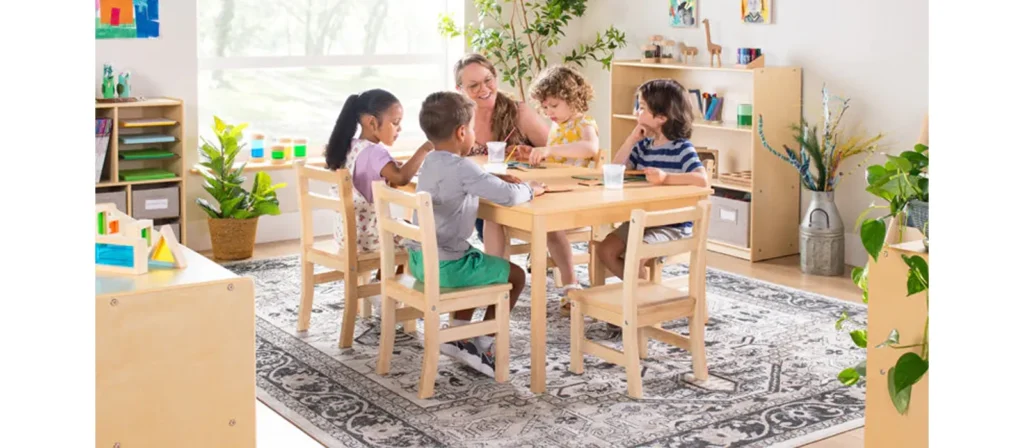
Furniture should also be sturdy, rounded, and easy to move. Light tables and shelves mean you can change the room layout without a full workout. When children can pull out a chair, push it in, and reach the tabletop safely, they feel more capable. That sense of comfort and control makes the learning environment friendlier for every age.
Storage and Material Accessibility by Age
ストレージ isn’t just about hiding clutter; it’s part of how children move and work in the room. In a mixed-age setup, you want frequently used materials on low shelves so most kids can get what they need and put it away themselves. More complex or fragile items can sit a bit higher, where older children or adults handle them. Clear baskets, photo labels, and simple symbols help even very young children understand where things live, which keeps the learning environment calmer and tidier.
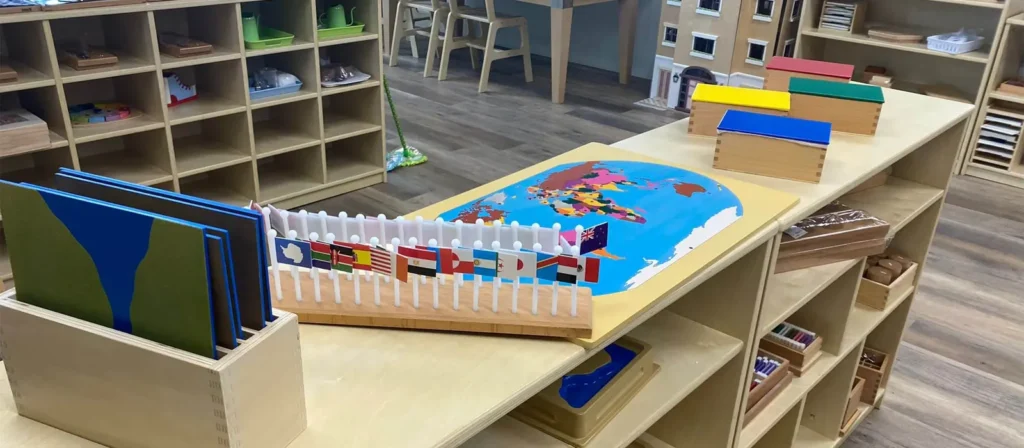
Reasonable Zone Division
Clearly defined learning zones are key to managing children of different ages learning in the same space. A good mixed-age classroom design might include a quiet reading corner, an active block area, an art area, and a desk and chair area for focused learning. Each area conveys a clear message, and children learn the rules of each area through practice.
At the same time, you need to observe most areas from one or two main locations. Reasonable zone division means you can accompany a small group of children while also keeping an eye on the others. Children have freedom to move around and choose, and you don’t have to constantly get up and check every corner. This balance between independence and supervision ensures a safe, peaceful, and sustainable mixed-age learning environment.
Challenges Schools Should Address
Mixed-age classes hold immense potential, but they are not plug-and-play. If schools implement them without a clear plan, a potentially beneficial environment for peer learning can become chaotic and stressful. Teachers may feel overwhelmed, parents may worry about insufficient attention, and the classroom atmosphere can quickly shift from “lively and active” to “noisy and chaotic.” View this model as a serious transformation, not just a seating arrangement.
One of the most challenging aspects is mindset and training. In mixed-age learning environments, teachers cannot rely solely on a simple grade list; they need a thorough understanding of children’s development across multiple age groups and genuine differentiated instruction skills. Without robust teacher training and sufficient planning time, even excellent teachers will feel overwhelmed. Schools should anticipate the learning curve, provide guidance, and give teams space for reflection, rather than blaming the mixed-age class model itself when initial difficulties arise.
Space and layout are another common challenge. If a classroom is designed for only one age group, its limitations will quickly become apparent: desks may be too high for some children and too low for others; items on bookshelves may be too high for younger children; or teaching aids may be unsafe for small children’s hands. Good learning environment planning means checking sightlines, movement paths, and furniture placement before children even enter the classroom. Investing upfront in flexible furniture, clever storage, and clearly defined learning areas can transform daily classroom management from a frantic, hectic affair to a calm and organized rhythm.
Supporting Multi Age Classrooms With the Right Furniture
For schools, it usually pays to think in terms of flexible, long-lasting commercial classroom furniture rather than “cute but temporary” pieces. Sturdy tables, stackable chairs in a couple of sizes, and low open shelving all help a mixed age classroom feel calm instead of crowded. Well-designed early learning furniture should support independence: children can sit properly, reach materials, and tidy up on their own, which takes pressure off teachers and keeps the environment running smoothly.
Where budgets allow, adjustable classroom furniture is a small superpower. Height-adjustable tables and versatile storage units can shift as your age mix changes from year to year, instead of forcing you to buy a whole new set every time enrollment tilts younger or older. Over time, that flexibility means your furniture keeps serving the multi age classroom instead of limiting it—letting the space grow and adapt alongside the children who learn in it.
Choose Top Montessoris furniture to make your multi-age classroom easier and more professional. Our adjustable classroom furniture is designed specifically for mixed-age learning. The right height, clever storage, and durable finishes make it suitable for everyday use. With the right layout, your teachers can reduce conflicts with the classroom space and spend more time interacting with the children; while parents will see a space that perfectly matches their vision for modern, high-quality early childhood education.





 JA
JA  EN
EN  AR
AR  FR
FR  IT
IT  DE
DE  ES
ES  TH
TH  TR
TR